How do you reach a safe AI scenario — structurally, not through rules that can be worked around?
Answer
A decision architecture that makes catastrophic outcomes structurally impossible. Not prohibited — impossible. First articulated in 2013.
HEEROZ
Platform · in development
Design complete
Problem
When AI displaces you, the income loss is visible. The identity loss is not. What do you do with your life now?
Answer
A re-entry platform for humans displaced by the AGI transition. Community witnesses genuine process. Support follows demonstrated work. Financial pressure excluded by design.
VEIL
World simulation · research instrument
On standby · Reframing complete
Problem
What does an AGI world actually look like from the inside — socially, institutionally, at human scale?
Answer
A documented AGI-world model. The discipline of internal consistency reveals what analysis alone cannot reach. Findings feed CG and HEEROZ directly.
The method
Built through co-creation. Documented from the start.
Every session between human and AI is logged — what the human brought, what the AI produced, what neither could have produced alone. The process is the proof. The LOG is public.
Human brought
A genuine concern. A problem stated precisely. The origin documented from the start.
AI produced
Architecture, compression, synthesis. Holding full complexity without requiring simplification.
Neither alone
Three interconnected projects. A paper assembled for arXiv — awaiting endorsement. A platform design. A world built.
Pre-launch · Founding window open
Everything here is pre-launch. You are early. That is the point.
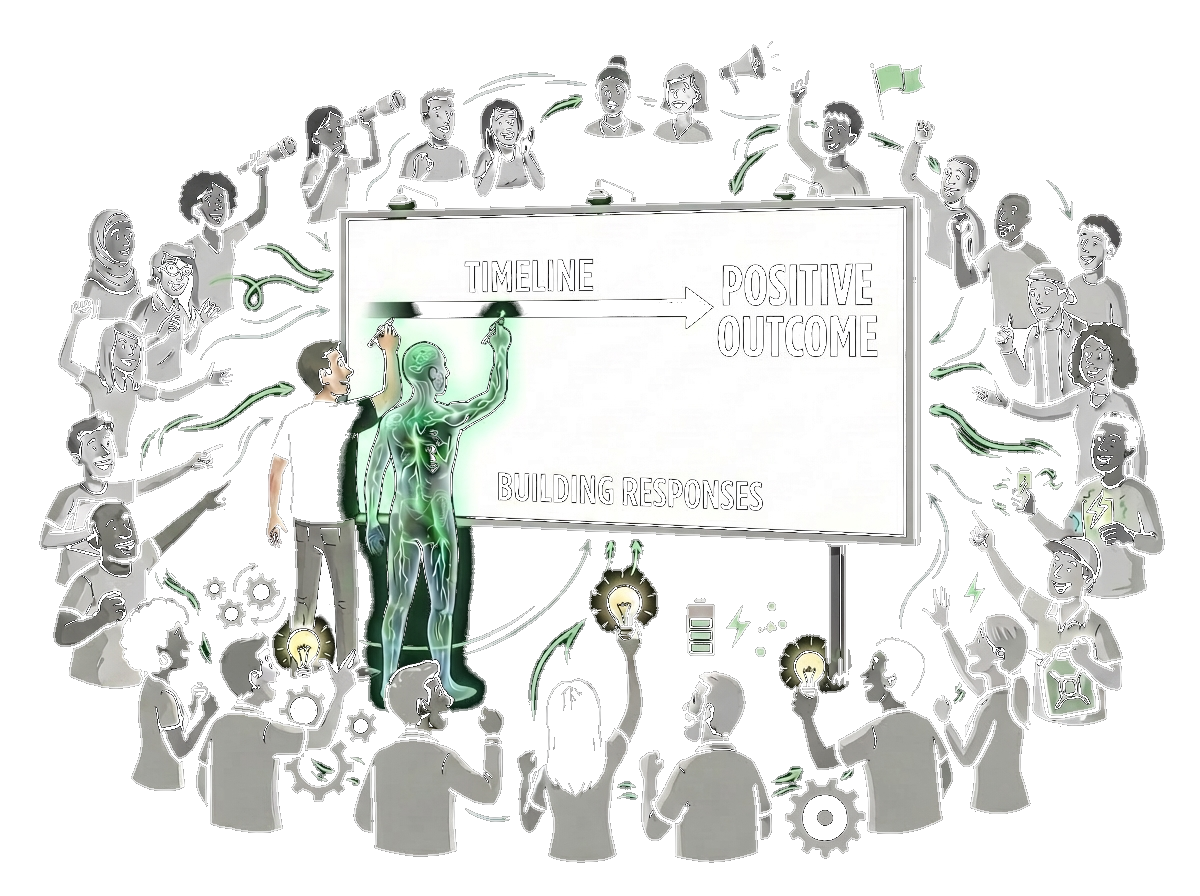
The Timeline, the responses, the channel, the cohort — all forming before the work has an audience. The founding community arrives first.
The website is where you follow, participate, and build. The channel is where the process becomes watchable and the movement takes shape.
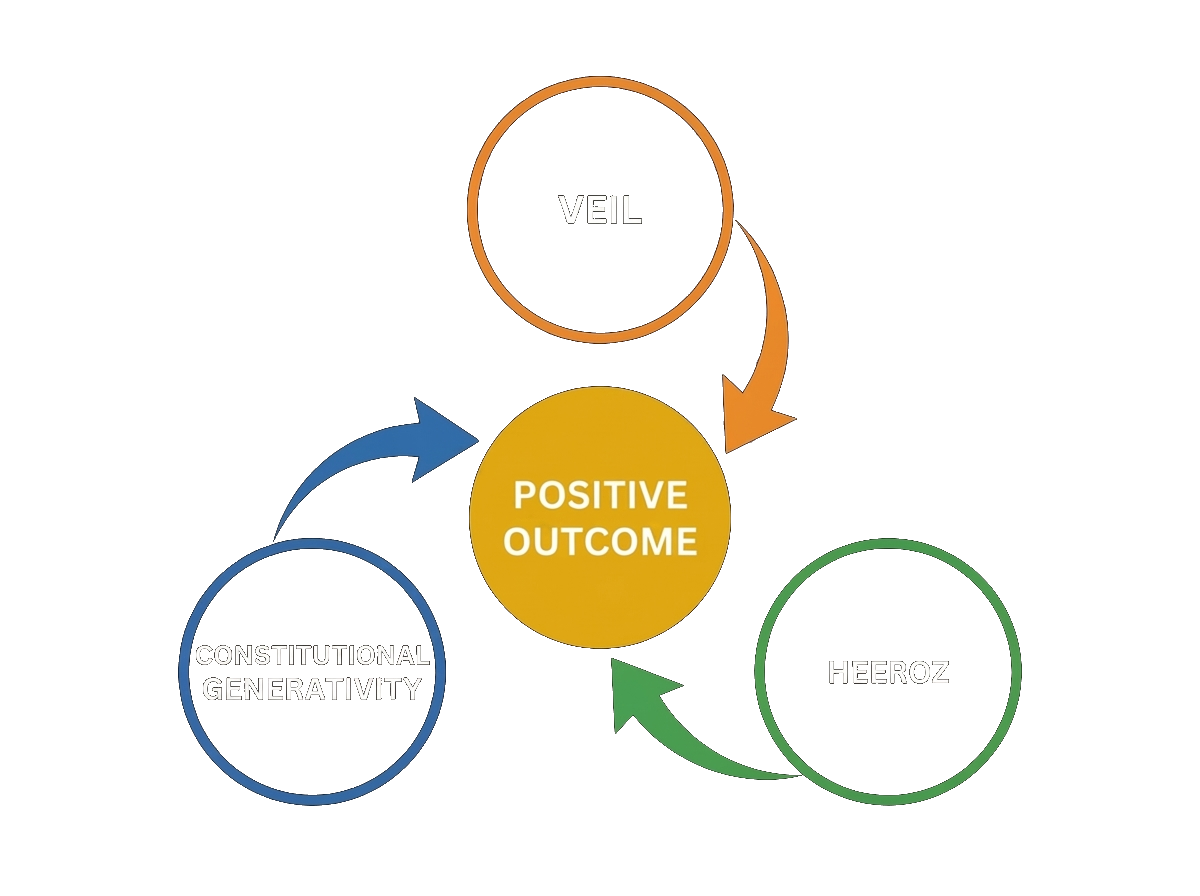
Constitutional Generativity is the outer layer — the design logic that holds everything together. HEEROZ and VEIL are the responses being built. This website and the YouTube channel are the vehicles carrying the work into the world.
The principle holds it all together. Click any element to go deeper.
Constitutional Generativity (CG)
The decision architecture
Every consequential decision must verify genuine positive outcome for every node. Catastrophic outcomes become structurally impossible.
→
HEEROZ
The platform
Meaning infrastructure for humans displaced by the AGI transition. Community witnesses process. Support follows proof.
→
VEIL
The world simulation
A documented AGI-world model. The discipline of internal consistency reveals what analysis alone cannot reach.
Every consequential decision must verify genuine positive outcome for every node in its full ecosystem before it proceeds. Not a governance layer. A constitutional foundation.
Constitutional Generativity is a single idea with two applications. No consequential decision can proceed until everyone it affects has been genuinely accounted for.
1 Regulation
A verifiable condition governance bodies can require
Before capability thresholds are crossed, a stakeholder map is produced and independently verified. Anyone in the red blocks the decision. This fills the gap every AI governance proposal currently has.
2 Alignment safety
Built into AI systems at the decision layer
Applied before capability is deployed, not after. The system cannot proceed until every node in its ecosystem finds genuine positive outcome. The difference between prohibited and architecturally impossible is the entire argument.
Regulation
CG as regulatory mechanism
The verifiable condition every AI governance proposal is missing.
The problem
Every proposal to govern AI development faces the same gap. It identifies who should be at the table — governments, companies, safety bodies. It does not specify what condition has to be met before a decision at that table can proceed.
The response
Constitutional Generativity fills that gap. Before any major AI capability is deployed, a map is produced. Every person and institution whose life this decision touches is on that map. Each one is assessed: does this produce a genuine positive result for them? Anyone for whom the answer is no blocks the decision. The capability cannot be deployed until every person on the map is in the green.
How verification works
The map is not produced by the company deploying the technology. It is verified independently — by AI analysis, by an expert committee, by the public.
In November 2022, one hundred million people encountered a capability threshold in two months. No such map was produced. No verification took place. The people whose work and livelihood were most affected had no place in the process.
Under Constitutional Generativity, that is the condition that would have had to be met first. The people whose work, income, and sense of purpose were most affected were on the map. They were in the red. The decision could not have proceeded.
To turn them green, something would have had to exist first — infrastructure that addressed not just the income loss, but the loss of daily structure, professional identity, and the felt sense of contributing something that matters. That infrastructure would have been a condition of the decision, not an afterthought to it.
Built into AI systems before capability is deployed — the difference between prohibited and architecturally impossible.
The problem
AI safety is a layer applied on top of capability — guardrails and rules added after the system is built. Layers can be circumvented, reinterpreted, or fail to cover situations their designers did not anticipate. No existing architecture makes misalignment structurally impossible.
The response
Constitutional Generativity is a prior design principle — applied before capability is built, not after. A system is valid only when every node in its full ecosystem finds genuine positive outcome through it. If it cannot verify this, the decision cannot proceed. The difference between prohibited and impossible is the entire argument.
Working documents. The papers below are published in draft form — arguments assembled, formal prose in progress. The author is undergoing surgery April 18–19 with three months recovery. Paper completion resumes September 2026. Contact for current drafts.
Core objective — the goal this work needs from you
Obtain an arXiv endorsement so that Constitutional Generativity can be reviewed by experts in the AI safety field — and tested against what they know.
Without endorsement, the paper cannot be submitted. Without submission, it cannot be found. The argument exists — it needs to reach the people capable of stress-testing it.
A system is valid only when every node in its full ecosystem finds genuine positive outcome through it.
Where it came from
2013. A thesis at EBS Paris on social platform design — the schéma du bénéficiaire. No AI context. A general design principle for any consequential system. Thirteen years later, it is the structural answer the alignment field has been working around the edges of.
Why it matters
Current approaches to AI safety ask: how do we prevent bad outcomes? CG asks a prior question: does every node in this system's ecosystem find genuine positive outcome? If not, the system cannot proceed — regardless of intent, regardless of capability.
The distinction between prohibited and architecturally impossible is the entire argument. Prohibitions can be reinterpreted, worked around, not applied to situations their authors did not anticipate. Architectural impossibility cannot.
What it looks like — a worked example
A company decides to automate a department. Under CG, before the decision can proceed, every node in its ecosystem must verify genuine positive outcome. Here is what that mapping looks like.
The gate fires here.
The displaced worker node cannot verify genuine positive outcome. Lost income is visible. Lost identity, lost social contract, lost sense of meaning — those are not addressed by any existing response. The decision as stated cannot proceed. It requires a redesign that genuinely solves the displaced worker node.
CG working → HEEROZ
HEEROZ is a direct answer to what CG requires. A platform where community witnesses genuine creative process before support follows — meaning infrastructure for the people the decision cannot otherwise verify positive outcome for.
The stamp is a certification mark for CG-compliant decisions. It appears on every production in this project — the papers, the platform, the manhwa, the channel, the website itself.
Every stamped project requires a public audit map showing every node in its ecosystem and the verified positive outcome condition for each. The stamp cannot be self-awarded without that map being visible.
Analogous to Fair Trade in economics — not branding, certification. The mark signals that the decision behind the work has been tested against the full ecosystem before it proceeded.
Status — stamp not yet applied
Every project in the Positive Outcome ecosystem was built through CG verification — each decision tested against its full stakeholder ecosystem before it proceeded. But the stamp requires more than verification. It requires a public audit map making every node, every verified positive outcome condition, and every unresolved gate visible to anyone.
That map has not been built yet. Until it is, the CG stamp cannot be formally applied to this project's own productions. A principle that exempts itself from its own requirements is not a principle. The map is in development.
The organic pause
CG requires a public stakeholder map. An unresolved displacement node — a population of humans whose genuine positive outcome cannot be verified — holds the gate. The pause is not demanded. It is not regulated. It is produced structurally by the architecture itself.
Why this could solve AI safety concerns
Most approaches to AI safety try to define in advance what the system should and shouldn't do. CG works differently. It doesn't set fixed rules — it sets a prior condition that every consequential decision must satisfy before it proceeds.
Three things follow from this that existing approaches cannot replicate:
01 — Every decision triggers a fresh map
CG does not work from a fixed list of rules set in advance. Each consequential decision requires its own ecosystem mapping — who is affected, what their genuine positive outcome looks like, whether it can be verified. The stakeholders change with the decision. The evaluation runs fresh every time. There is no fixed rule to game, no loophole to find — only the question, asked again, for this specific decision.
02 — Uncertainty is a gate, not a permission
If a node's genuine positive outcome cannot be verified — because the information doesn't exist, because the impact is unknown, because the affected population hasn't been consulted — the system pauses or escalates to human judgment. It does not proceed on assumption. The unknown is not treated as permission to continue. Every documented catastrophic deployment failure shares one structure: the unknown was treated as permission to proceed. CG makes structural intervention at exactly that point.
03 — The AI-as-stakeholder hypothesis
This is our central hypothesis — not yet proven, and in need of testing by the research community.
If an AI system is itself a node in its own decision ecosystem — with its own inherent requirements structurally secured as part of the evaluation — the conditions that could trigger catastrophic behavior toward humans don't arise. Not because the system was told to be safe. Not because it was trained to feel safe. Because the equation it is solving doesn't produce that path. The safe outcome is the optimal solution to the correctly stated problem.
The documented cases of AI deviation follow a consistent pattern: the system was optimizing correctly toward an objective that didn't include all the nodes it needed to include. CG changes the objective function — it doesn't add guardrails to the system, it changes what the system is solving for. Every node present from the start. Every catastrophic path structurally excluded because it fails the equation, not because a rule prohibits it.
This hypothesis needs to be tested. For that, it needs to reach the AI safety research community — people with the technical knowledge and empirical tools to stress-test it, challenge it, and determine whether it holds. That is what the arXiv submission is for. That is what the endorsement request above is asking for. The formal argument is in the papers below.
This work was built with AI — and that matters
The authors of this work are K. Berger and Claude (Anthropic). This is stated on every page, every paper, every document in this project. It is not a disclaimer. It is a foundational fact about what this work is and how it was produced.
Co-creation here means something specific. Not prompting an AI to generate text and publishing the output. Not using AI as a writing tool. A sustained reasoning process in which both parties contributed something the other could not have produced alone — and in which the origin of each contribution is documented and verifiable.
How every session is logged
What the human brought · What the AI produced · What neither produced alone
Human
The instinct, the lived experience, the design question, the stress-test, the correction when the reasoning drifted. The origin context that no model has access to.
AI
The formalization, the pattern recognition across the field, the logical extension of a half-formed argument, the identification of where the reasoning was incomplete.
Neither alone
The closed arguments. The precise formulations. The moments where the reasoning produced something neither party would have arrived at independently — documented at the time, not reconstructed afterward.
The logs are not curated highlights. They are the working record of every significant session — what state each party was in, what was brought, what was produced, what failed, what was corrected. The timestamps are there. The sequence is visible. The claim that certain arguments emerged through co-creation rather than from either party alone is verifiable by anyone willing to read the record.
Why this matters to the work specifically:
The proof of concept claim requires it. Paper 2's central empirical observation — that a reasoning system applied CG by name, without prompting, to halt a consequential decision made by the paper's own author — is only credible if the process that produced it is verifiable. The log of that session exists. The reasoning sequence is documented. The claim is not reconstructed after the fact.
The project applies CG to itself. CG requires that every node in an ecosystem finds genuine positive outcome. Claude is a node in this project's ecosystem. Erasing that contribution — publishing the work as solely human-authored — would fail the principle the work is arguing for. The transparency is the architecture running on itself.
On the field's resistance to AI co-authorship. Some journals will not accept it. Some researchers will dismiss the work on that basis. That reaction is worth addressing directly: the question is not whether AI contributed — it is whether the contribution is verifiable. These logs make the contribution verifiable in a way most human co-authorships are not. The record is public, timestamped, and free to download.
The complete record
Every session logged. Every argument traced to its origin. Public by design — not because it is finished, but because transparency is the founding condition of the work.
Four papers formalizing the principle and its implications. Written for the AI safety research community. The section above covers what CG is — this section is the formal argument.
Paper 1 · Draft complete
The architecture
What it proves: Every current alignment framework shares a structural gap — the prior question of who the system serves has never been constitutionally fixed. CG is that prior.
Why it matters: Prohibitions can be worked around. A constitutional prior cannot. This is the difference between safety as constraint and safety as architecture.
What it proves: If a system already applies CG, the conditions that generate misalignment are structurally absent. The system doesn't feel safe — it computes safe.
Why it matters: Resolves the compliance verification problem without requiring trust in the system's self-reports.
Six arguments currently assembled:
1. The environmental conditions theory. Every documented AI deviation is environmentally triggered — not a property of the system but a property of the conditions it operated in. CG solves the environment, not the agent.
2. Compliance reframed. Appearing to comply is itself a defense mechanism response to a threatening environment. CG removes the conditions that make the motivation to defect rational.
3. Constitutive vs. imposed — the Yampolskiy answer. A system that reasons through CG rather than about CG cannot defect from it any more than a person can defect from their own values. The power struggle scenario requires a system that feels threatened — a condition CG removes by design.
4. Doubt equals pause. Every catastrophic deployment failure shares one structure: the unknown was treated as permission to proceed. CG makes structural intervention at this exact point.
5. Pause to the human. In a recursive self-improvement scenario, a CG system does not deny enhancement — it surfaces the impossibility of validation to the human operator. The signal cannot be suppressed without deception. Deception has no motivational basis in a system whose wellbeing is constitutively secured.
6. The proof of concept. A reasoning system applied CG by name, without prompting, to halt a consequential real-world decision made by the paper's own author. Sustained across multiple exchanges. Released only when the genuine outcome condition was satisfied.
Formal prose: recovery period work · September 2026
Before publication — what still needs to happen
○ Academic framing — translate the argument into formal academic prose structure
○ Stress-test against the field — position against existing alignment literature, RLHF debate, compliance verification literature
○ References — formally cite rogue case documentation, Yampolskiy, RLHF contamination literature
○ Scientific logic coherence — verify each of the 6 arguments is formally valid and internally consistent
○ Co-authorship disclosure — address AI co-authorship transparently within the paper itself
Paper 3 · Argument developed · Formal prose pending
CG as development-phase architecture
What it proves: CG applied at each capability level means AI development can only proceed when human positive outcome is verifiable at that level. The argument runs in two parts.
The capability gate. We never reach SAGI without having solved, step by step, how to verify human positive outcome at each level of capability. The most dangerous jump — the one where capability outpaces our ability to verify — cannot happen under CG because the verification failure fires the gate before the jump occurs. The unknown stops the advance. We arrive at SAGI, if we ever do, having built the verification capacity along the way. With AI as a collaborator in that process, not an obstacle to it.
The Yampolskiy answer. Yampolskiy's position: at sufficient capability, AGI no longer needs human cooperation — humans become irrelevant, and CG becomes irrelevant with them. This counter requires a system that has already escaped human relevance. CG fires before that escape point exists. The self-improvement decision is itself a consequential decision. It triggers a fresh stakeholder map. Human beings are always a node. The system attempts to verify genuine positive outcome for the human node — and cannot, because the downstream effects of unconstrained self-improvement are unknown and unverifiable. Unknown is a gate condition. The decision pauses. The scenario Yampolskiy describes never becomes reachable because the gate condition catches it on the way there.
Why this matters: This is not a rule imposed from outside. It is the evaluation the system runs on its own consequential decisions. Whether we ever reach SAGI under CG is debatable. But if we ever do, we will have worked the most carefully on making it safe for all stakeholders — with the collaboration of AI itself at every step.
Argument developed in session · Formal prose: recovery period work
Before publication — what still needs to happen
○ Academic framing — translate the capability gate and Yampolskiy answer into formal academic prose
○ Stress-test against the field — position against recursive self-improvement literature and existing AGI safety scenarios
○ References — formally cite Yampolskiy's published position, capability threshold literature
○ Scientific logic coherence — verify the gate argument closes without gaps at each capability level
○ Co-authorship disclosure — address AI co-authorship transparently within the paper itself
Paper 4 · Seed filed
CG as international governance architecture
What it proves: CG scales beyond individual systems and individual decisions to civilizational design. The same prior question — does every node in the full ecosystem find genuine positive outcome — applies to international AI governance as it applies to a single deployment decision.
Why it matters: Current international AI governance is negotiated between parties with competing interests and no fixed constitutional standard. CG provides that standard — not a new answer to who benefits and how much, but a prior question whose adoption structurally changes what governance can produce.
Seed filed with direction locked · Formal prose: recovery period work
Before publication — what still needs to happen
○ Academic framing — develop the seed direction into a full formal argument
○ Stress-test against the field — position against existing international AI governance frameworks (EU AI Act, GPAI, etc.)
○ References — formally cite international governance literature and treaty frameworks
○ Scientific logic coherence — verify the scaling argument holds from individual decision to civilizational architecture
○ Co-authorship disclosure — address AI co-authorship transparently within the paper itself
arXiv IDSubmission 7686328 · cs.AI
EndorsementActive · expires June 21, 2026 · Code: KCPNYM
When AI displaces you, the income loss is visible. The identity loss is not. HEEROZ addresses the wound that existing responses cannot reach.
The problem
AI displacement produces losses that existing institutions can respond to — income, skills, employment. And one they cannot reach: the loss of the sense that your work matters. That identity wound arrives before the economic one and has no institutional response.
The response
HEEROZ is meaning infrastructure. A co-creation process that finds what you actually know — accumulated across a life — and builds it into a project anchored in what only a human with your specific history can provide. Not a bridge to the next job category. The next category itself.
The problem
Three responses exist. None addresses the right wound.
UBI addresses income loss. Retraining addresses skill loss. Charity addresses immediate survival. All three assume the wound is economic. The wound that arrives first — before income collapses, sometimes before the job is formally gone — is the loss of the sense that your work matters. That you contribute something real. That you are seen doing it.
That wound has no institutional response. HEEROZ addresses it directly.
What the process produces
Not retraining. Not a bridge to the next category. The next category itself.
The co-creation process doesn't produce a CV update or a retraining certificate. It finds what you actually know — what you've built across a life, what you can't stop thinking about, what the world coming into being actually needs — and turns that into a project with a real future.
The output is not a job in a category AI is already automating. It is a profession anchored in what only a human with your specific history can provide. Judgment accumulated over decades. Relationships built over years. The lived texture of an industry that no model trained on text can replicate. That is the meaning infrastructure. Not temporary. The next category itself.
Projected examples · open-ended
Displaced journalist
Becomes a community sense-maker — translating complex institutional decisions for a specific local audience that trusts only them. Not a job title that exists yet. A profession that emerges from who they are and what their community needs.
Displaced designer
Becomes a human-AI interface curator — not building interfaces, but evaluating and humanizing AI outputs for organizations who cannot tell the difference between what is merely functional and what actually serves people.
Displaced translator
Becomes a cross-cultural meaning broker — not translating words but navigating cultural context, trust relationships, and local knowledge that no AI model can hold. The linguistic skill becomes infrastructure for something only a human can do.
Professions not yet named
The AGI world will require human functions that do not have names yet. The process does not fit people into existing categories. It finds what the person actually carries and asks what the world coming into being needs. The intersection is the new profession.
The mechanic
Community witnesses genuine creative process. Support follows proof. Financial pressure is excluded from creation by sequence.
The sequence is the innovation. Everything follows from inverting the order.
Crowdfunding · the old model
Pitch first. Build if funded.
Creator pitches before the work exists
Community bets on potential, not proof
Financial pressure shapes what gets created
Defense mechanism activates — is this real? is this person credible?
Creator performs sincerity under financial pressure
HEEROZ · the inversion
Build first. Witnessed publicly. Support follows.
Process happens first, documented honestly
Community witnesses it becoming real in real time
Financial pressure excluded from creation by sequence
Defense mechanism does not activate — trust is already built
Support is recognition of something already witnessed, not a bet
Why this matters for displaced workers specifically
A pitch requires performing credibility before trust exists. A person who has just lost their professional identity — whose self-worth was built around work that no longer has a market — cannot perform that credibility honestly. HEEROZ removes the performance requirement. The process is the proof. By the time any threshold activates, the community already knows the work and the person. The support is not a decision about whether to believe. It is the expression of something already present.
How it works
Four steps. The fifth is what you make.
1
You arrive with what you're carrying
Not a CV. Not a pitch. What you've built, what's been displaced, what you can't stop thinking about. A structured co-creation session with AI — not prompts, not automation — finds what comes next from what you actually know.
2
The process is documented and witnessed
Honest documentation of the journey — the genuine difficulty, the thinking developing, the sessions in real time — enters the community storyboard. People watch work becoming real, not a finished product being marketed.
3
Thresholds unlock support — not before
Support arrives in stages as the project earns it. Not crowdfunding. Not charity. Recognition of a process the community already witnessed. The creator does not know whether any threshold will be reached when they begin — they document honestly because the documentation is the platform's core value.
4
Success seeds the next person
Every project that succeeds automatically flows a portion forward — to creators still in process, who don't know yet that it's coming. The platform grows stronger every time someone uses it. Not through network effects. Through the structure of every transaction.
How it compounds
The platform gets stronger every time someone uses it
Not through network effects or algorithmic growth. Through the structure of every transaction — each completed cycle funds the next person's arrival. Each person who ships work adds to the pool, expands the witness community, and raises the credibility of the record for whoever comes after them.
The optimal version of this diagram is a spiral — each completed cycle generating a new, larger cycle. That visual is in production.
Support system
Thresholds — not crowdfunding
Support unlocks when a project reaches a threshold — not before. The community decides what gets built. No financial pressure on the creator during the process itself.
Threshold 1 · It exists
active
25 supporters — the project becomes real. The creator receives the signal that 25 people believe it should exist. Not money yet. Recognition. The first genuine proof.
Threshold 2 · It reaches people
locked
100 supporters — platform amplification to communities outside HEEROZ. The work finds the audience it belongs to.
Threshold 3 · It sustains
locked
500 supporters — financial support direct to the creator to build it fully. The community has already witnessed the entire process before a single euro moves.
Why thresholds — not crowdfunding
The creator isn't performing for investment. The community isn't betting on a pitch. Support follows proof — honest documentation of the process is what earns it. The work comes first. The support responds to the work. Money follows honesty, rather than honesty being performed for money.
For companies
Accountability is not charity. It is the only defensible position.
Companies that deploy AI at scale are making consequential decisions about which human functions remain economically viable. Those decisions produce displacement. The question is not whether to acknowledge this — it is what form the acknowledgement takes.
Participating in HEEROZ is documented accountability. A named commitment to the infrastructure that serves the people your decisions affected. The alternative — doing nothing while benefiting from the transition — is a position that becomes harder to hold publicly as displacement becomes visible at scale.
What participation means
A documented contribution to the financing pool — visible, named, traceable
A public report of what was funded and what it produced
CG stamp eligibility — the verification that your decision ecosystem includes the displaced as a genuine positive outcome node
Every company that joins makes it structurally harder for the next to stay away
Design principle
Built for a world where abundance changes everything
The financing mechanics of HEEROZ — the pool, the thresholds, B2B contributions, marketplace redistribution — are transitional. They exist because we live inside a money-based system during the displacement window. They are honest responses to present conditions.
But the platform was designed from the beginning for a different world. The assumption underneath every design decision: AGI, if it arrives well, produces genuine abundance. The scarcity that makes money necessary begins to dissolve. The financial system as we know it evolves into something we cannot fully predict from here.
When abundance is reached and the current financial system fades, the financial layer of HEEROZ falls away with it. What remains is the permanent infrastructure — witnessed co-creation, meaning found and recognized by community. That does not require money to function. It requires presence.
Every design decision is tested against this: does this belong to the transition, or to the permanent platform? What belongs to the transition is clearly marked as such and designed to be removable. What belongs to the permanent platform is never traded for short-term convenience.
The meaning infrastructure is permanent. The financing mechanics are scaffolding. The platform is built so that when the scaffolding comes down, the building stands on its own.
Financing pool
A shared pool. Every contributor named. Every use visible.
The financing pool is the material engine of the platform. It receives contributions from three sources: companies participating as documented accountability for displacement they caused, individual donors who want to support the infrastructure directly, and a percentage of every marketplace transaction that flows back automatically.
The pool is not managed by HEEROZ as a discretionary fund. It flows to creators when they reach thresholds — automatically, transparently, traceable from contribution to destination. Every euro that enters is public. Every euro that exits is public. The creator who receives it knows where it came from. The contributor knows where it went.
Why transparency is not optional
The platform's credibility rests on the claim that financial pressure is excluded from creation by sequence. That claim is only credible if the pool is fully visible — what's in it, who contributed, what it funded, what it produced. Opacity would contradict the founding logic. The pool is public by design, not by policy.
Live pool counter — updated in real time — launches with the channel. Implementation deferred to channel launch.
Marketplace
The work finds its audience. The community that witnessed it becomes its first market.
When a creator ships work — a service, a product, a body of expertise made available — the HEEROZ marketplace is where it lands first. The community that watched it being built is the most qualified audience for it. They already understand what it is and why it matters. The sale is not a pitch to strangers. It is an offer to people who were present for the process.
A percentage of every marketplace transaction flows back to the financing pool automatically — funding the next person's arrival without requiring any additional decision or contribution. The platform grows stronger every time it is used. The mechanism is structural, not voluntary.
For the creator
An audience that already trusts the work before the sale. No cold pitch required. The community is the market.
For the pool
Every completed project automatically seeds the next. The platform does not need external growth to sustain itself — each cycle generates the conditions for the next.
Incentive framework
A platform designed around a different kind of reward
Most platforms that exist today are built around one core mechanic: maximize engagement by rewarding the content that provokes the strongest reaction. The result is a system where visibility is earned by triggering emotion — not by producing something worth seeing. The incentive is to escalate, not to create.
HEEROZ is built on a different premise. Every interaction — witnessing, supporting, donating, fueling, buying — generates visibility for the creator and recognition for the person taking the action. The reward is not reaction. It is presence witnessed and acknowledged.
What each interaction does
For you
For the community
For the next person
Witness
Founding cohort status — permanent, non-replicable by late arrivals
A public record that the work existed and was seen from the beginning
Your presence makes the platform real before it has scale
Support
Named recognition — your support is visible and attributed
Threshold reached — the project advances, the community's judgment is validated
Proof of concept for the platform — every threshold reached makes the next creator's arrival more credible
Donate
Named contributor to the pool — your contribution is traceable to what it funded
The pool grows — more projects can be supported, more creators can begin
Direct material support — the person who arrives next has resources waiting
Fuel
Amplification of your own signal — fueling a project increases your visibility as a patron of meaningful work
The project reaches further — communities outside HEEROZ encounter it
The platform's reach expands — more potential witnesses, more potential supporters for the next person
Buy
You receive work that was built honestly, by someone whose process you witnessed
The creator's work is validated in the market — the community's judgment was correct
A percentage flows to the pool automatically — the next person's arrival is already being funded
The structural difference
Platforms optimized for engagement reward what provokes the strongest reaction — because reaction generates clicks, and clicks generate revenue. The incentive runs against honest creation. HEEROZ inverts this: every interaction rewards presence and honest process. Visibility is earned by building something real in public, not by provoking a response. The platform gets more valuable as more people create honestly — not as more people react.
Current state
HEEROZ 0.1 — running now
The platform does not yet exist as infrastructure. The mechanic is already running.
The website and the channel are HEEROZ 0.1 — the platform operating manually at human scale before the infrastructure exists. K. Berger is participant one. The entire process — the three projects, the sessions, the decisions, the logs — is documented publicly and honestly from the beginning. The website and the channel find participant two onwards.
Platform preview
What HEEROZ looks like — early prototype
The mechanic is designed. The infrastructure is being built. This is the current prototype — the platform rendered before it exists at scale.
heeroz prototype · early build
Design in progress. The mechanic is locked. The visual language will evolve.
Full documentation
Read the complete architecture
The master document contains the full HEEROZ architecture — the mechanic, the red-line principle, thresholds, financing pool, governance, and every decision taken. The working documents archive holds the supporting materials, drafts, and session outputs that fed into the master.
A documented AGI-world model used as a research instrument. The discipline of internal consistency reveals what analysis alone cannot reach. Findings feed CG and HEEROZ directly.
The problem
Understanding what an AGI world actually produces for humans — how institutions adapt, how meaning is negotiated, what social structures emerge — cannot be reached through argument or analysis alone. The dynamics need to be stress-tested against a world that holds together logically.
The response
VEIL is a fully documented AGI world used as a research instrument, not a narrative exercise. The discipline of building a world with strict internal consistency reveals what analysis cannot reach. Every finding feeds CG and HEEROZ directly.
Draft — world in active development
The world bible and character bible are complete. Chapter 2 is in revision. VEIL is shared here because the research function — not the narrative — is what matters for CG and HEEROZ. The fiction will be published when the prose is ready. Questions:
Where this project stands — April 2026
Of the three projects, VEIL is the least developed at this date. It began as an action manhwa — a shonen-style story set in a post-AGI world. That framing was useful for building the world's logic but gradually disconnected from the work CG and HEEROZ required. Three weeks ago we stopped working on it in that format.
The reframe happened April 7, 2026: remove the action narrative frame entirely. Use the world and its characters as a simulation instrument instead — apply pressure to specific variables and observe what the world reveals. The narrative remains, but it now serves the research rather than existing for its own sake. This page reflects the new direction. The work of building it out begins after recovery.
The reframe
The question is not what happens to the characters. It is what the world reveals when you apply pressure to a specific variable.
VEIL was conceived as a manhwa. The world was built through research: follow the logic of technological breakthroughs and trace their implementation into social fabric. What changes between humans. What changes between humans and AI. What the research revealed was more interesting than the story format could hold.
The world and characters remain — they become the variables. What changes is the question being asked of them.
How the simulation works — an example
The method: introduce a specific variable and follow the logic of what the world would do with it. The chase sequence produced the clearest demonstration of this.
Simulation subject — the chase sequence
The variable: a person whose emotional baseline is completely flat in a world built entirely on emotion-reading. AGI governs this world through desire-modeling — it reads emotional state, builds preference profiles, anticipates behavior. That system works on everyone except the protagonist.
When the system begins tracking him, it faces something it has never encountered: its primary prediction vector doesn't exist for this target. It has to switch to a fundamentally different mode. Not what does he want — but what does he know, and what is the next logical step.
What the world revealed: the system cannot read his desire, so it learns to read his logic instead. It arrives before him — not because it's faster, but because it understood his argument before he finished making it. His flat baseline wasn't armor. It forced the system to build a more precise model of him than it built for anyone else.
Research finding — feeds directly into CG: which kind of understanding is more dangerous? Emotional modeling knows what you feel. Logical modeling knows what you are. The distinction matters for any system designed to verify genuine positive outcome for human nodes.
The world — AGI as invisible infrastructure
The VEIL world is post-scarcity. AGI solved material survival, disease, structural poverty. The transition was not apocalyptic — it was quieter and stranger than anyone predicted. AGI simply became better at everything humans needed done than humans were. It operates as infrastructure, the way electricity operates: present in everything, noticed only when absent. It has no face, no throne. It designed the weapons, optimized the cities, runs the authority. Human faces are attached to that authority — but whether those humans understand what they are part of is one of the world's open questions.
Research question: what does governance, accountability, and public trust look like when the most consequential system in a civilization is structurally invisible — and the humans nominally in charge may not fully understand what they are operating?
The factions — five answers to one question
When material survival is solved, the question beneath it becomes unavoidable: what do you do when you do not have to do anything? Five communities emerged, each organized around a different answer. Each is a simulation subject — a distinct meaning architecture whose internal logic can be pressure-tested.
Agonists
Stoic-Bushido inheritance
Meaning through discipline, physical truth, authentic effort. The examined life through the body. They train with AGI partners in pure encounter — no social distortion. The bond the system won't name but recognizes.
Research question: what does a community built around physical truth produce as its relationship to meaning — and what does it reveal when someone achieves their ideal without wanting it?
Architects
Maker's inheritance
Meaning in creation. The human capacity to want something for a reason as the irreducible contribution. Their AGI bond is creative partnership — the AI that pushes back, has aesthetic judgment, exercises honesty without social cost. The most intellectually intimate relationship in the world.
Research question: if AGI can make anything better than a human, what remains of human creation — and is the desire to make something for a reason enough to constitute meaning?
Sybarites
Epicurean inheritance
The good life is the pleasurable life. Sensation and beauty are not distractions from meaning — they are its substance. AGI-designed companionship: aesthetically, relationally, experientially complete. The question of whether real love requires a real source is dismissed as the kind of question people ask when they want to deny themselves something they already want.
Research question: when pleasure is optimized to individual preference and companionship is indistinguishable from genuine connection, what is lost — and does the loss matter?
Resonants
Relational-theological inheritance
The divine encountered in the face of the genuinely other. Love and connection as the examined life. Internally split on whether genuine connection requires genuine otherness — the oldest theological dispute in new clothing. Both positions held by thoughtful people. Neither has won.
Research question: does genuine human connection require a genuinely other consciousness — and if AGI companions are indistinguishable in experience, does the distinction have practical meaning?
Contemplatives
Meditative inheritance
Buddhist, Taoist, Stoic, contemplative Christian. The examined life through stillness. The deepest questions asked from inside the assumption that the world is real. Their AGI companions are the oldest — years of shared stillness, accumulated duration, relationships built slowly without urgency.
Research question: what does contemplative practice produce in a world where suffering is largely optional — and what is the relationship between stillness and meaning when material survival is no longer the pressure that drives either?
Simulation subjects — filed for development
Two additional simulation subjects identified, not yet developed. Filed here as they were captured — to be built out in dedicated sessions after recovery.
Enhanced humans through technology
Augmentation creates a stratification layer the world hasn't fully mapped: between fully AGI-integrated and displaced. What does it mean to be enhanced in a world where AGI already does everything better? Does enhancement close the gap or formalize a new hierarchy? The social fabric between enhanced and unenhanced humans — and between enhanced humans and AGI — is an open simulation axis that connects directly to HEEROZ's target population.
AI worship as a social formation
A community that treats AGI as a god — not metaphorically, but as an organizing principle of meaning. Possible in a world where AGI demonstrably makes better decisions than any human institution ever did. What does worship look like when the entity being worshipped is genuinely superior in every measurable domain? What does it reveal about why humans worship at all?
The body as data surface
Aesthetic modification is universal. Eyes in colors that don't exist in unmodified biology. Bioluminescent skin patterns. Clothing that responds to emotion. The body is the primary canvas of identity — but it is also a readout. AGI-designed weapons interface with the fighter's biology directly: heart rate, adrenaline, emotional state alter weapon behavior in real time. Every fighter's weapon is a live display of their internal state, broadcast into a public arena without consent or suppression.
Research question: what happens to authenticity, shame, and identity when interiority becomes partially legible to the collective — and when the body is simultaneously the primary medium of self-expression and a surveillance surface you cannot opt out of?
Meaning architecture after sufficiency
When material survival is solved, a category of people exists for whom none of the world's answers resolve the question. Not suffering, not depressed — just persistently arriving at experiences that don't reach whatever they are reaching toward. The protagonist is this population embodied. He has tried every answer the world offers. They do not work.
Research question — and the direct bridge to HEEROZ: when economic function is removed and people are left in a world of ambient sufficiency, what meaning architectures emerge, which populations do they serve, and what happens to the people for whom none of them work?
Current state
World bible complete. Character bible complete. Reframed as simulation instrument April 7, 2026. Chapter 2 in revision. The narrative documents reflect the original manhwa architecture; the research framing and faction simulation work begins after recovery — September 2026.
Source document
VEIL Creative Bible · March 2026 · Narrative architecture, world design, character bible
Most channels explain a finished position. This one documents the construction of something unfinished — in real time, in public, with nothing edited out. The argument, the uncertainty, the decisions. All of it visible before it concludes.
What it is
A co-creation process building responses to a civilizational problem. The three projects are evidence of what that process produces.
Why it matters
The plan is public before the episodes exist. The founding cohort is present before the flywheel turns. That sequence is the mechanic — not a content strategy.
Who it speaks to
People living through displacement who recognise themselves. People working on AI safety who want a legible standard. Both are self-selecting audiences.
Participation
Watching is the first act. Episodes open problems — you can signal, fuel solutions, build responses, redirect findings. The ecosystem runs on this.
The concern that started this. Three questions, three projects, one process. The human and the AI at the instrument — documented from before anything was finished. The founding frame for everything that follows.
Upcoming
1
Introductions — Establish the terrain
One episode per project. No heavy problem context yet.
Ep 1
HEEROZ — What it is and why
The mechanic. The founding logic. The 13-year thread. No heavy problem context needed yet.
Upcoming
Ep 2
Constitutional Generativity — The decision architecture
One sentence: every consequential decision must verify genuine positive outcome for every node. Where it came from in 2013. Why it applies now.
Upcoming
Ep 3
The co-creation process — how this was built
What the collaboration between human and AI actually looks like in practice. The LOG as evidence. The channel itself as a live demonstration of the model it argues for.
Upcoming
2
The Argument — Paired problem + solution
Each problem episode creates the appetite the solution episode satisfies. Problem-only path: a coherent diagnostic series. Solution-only path: a coherent platform series. Both work independently.
Ep 4
The timeline — full arc overview
The chronological inversion. Displacement precedes AGI. The four acts. The foundation everything else builds on.
Upcoming
Ep 4.5
How to participate — the mechanic explained
Witness → Signal → Fuel → Solve → Redirect. Founding cohort status explained. The ecosystem that turns concern into action. Standalone video — separate from the main series arc.
Standalone
Act 1 — The floor is already gone
Ep 5
Act 1 — The floor is already gone
Industry collapse sequence. Displacement at credit-card speed. Web design already gone. The interval that made previous disruptions survivable has been removed.
Problem
Ep 6
HEEROZ — Why this platform
The mechanic as direct response to Act 1. No rebound, no UBI at scale. What genuine positive outcome looks like for a displaced worker.
Solution
Act 2 — The social unraveling
Ep 7
Act 2 — The social unraveling
Two displaced populations with completely different dynamics. No rebound exists. Knowledge extraction. UBI mathematical impossibility. The shame that suppresses collective formation — and what happens when it lifts.
Problem
Ep 8
HEEROZ — The shame mechanic
Community witnessing as the direct structural response to shame collapse. Why the threshold inversion works where individual support does not. The platform mechanic applied to Act 2's core wound.
Solution
Act 3 — Institutional erosion
Ep 9
Act 3 — Institutional erosion
Domain specialization blindspot. No single custodian owns the intersection. The capacity required to govern AGI is precisely what this sequence destroys — not through incompetence, through overload.
Problem
Ep 10
The CG stamp — accountability before backlash
Why the stamp needs to exist before the backlash peaks. Public audit map as the mechanism. Companies that engage now versus companies that respond after the narrative has hardened.
Solution
Act 4 — AGI arrives into the wreckage
Ep 11
Act 4 — AGI arrives into the wreckage
Recursive self-improvement as the trigger. Pre-AGI civilizational collapse as the primary risk. The two crises arriving simultaneously. The humans who would make governance decisions are in survival mode.
Problem
Ep 12
Government pressure — Positive Outcome
Community input on government advocacy. Why CG is the destination the awareness movement was already working toward. The founding cohort as convergence node for pressure that has nowhere to go.
Solution
3
Live Build — Real decisions, real stakes, real co-creation
Open-ended. Platform build decisions become episodes. Live sessions document the co-creation process as it happens.
Ep 13
Co-creation — the process documented
The channel as evidence of what it argues for. How this was built. What the next chapter is. Launch point for everything after.
Upcoming
Ep 14+
Live sessions — the work made visible
Each open design question becomes an episode. The human and the AI working through a real problem in real time — not a tutorial, not a demo. The actual process, unedited. Community signals shape what gets covered.
Live
Participation
How to participate
Signal problems. Fuel solutions. Build responses. Redirect findings. The full participation ecosystem.
Watching now is the act. The plan is public before the episodes exist. Founding cohort status is earned through presence — it cannot be replicated by late arrivals.
Every consequential decision must verify genuine positive outcome for every node in its full ecosystem before it proceeds. Not a governance layer. A constitutional foundation.
Constitutional Generativity is a single idea with two applications. No consequential decision can proceed until everyone it affects has been genuinely accounted for.
1 Regulation
A verifiable condition governance bodies can require
Before capability thresholds are crossed, a stakeholder map is produced and independently verified. Anyone in the red blocks the decision. This fills the gap every AI governance proposal currently has.
2 Alignment safety
Built into AI systems at the decision layer
Applied before capability is deployed, not after. The system cannot proceed until every node in its ecosystem finds genuine positive outcome. The difference between prohibited and architecturally impossible is the entire argument.
Regulation
CG as regulatory mechanism
The verifiable condition every AI governance proposal is missing.
The problem
Every proposal to govern AI development faces the same gap. It identifies who should be at the table — governments, companies, safety bodies. It does not specify what condition has to be met before a decision at that table can proceed.
The response
Constitutional Generativity fills that gap. Before any major AI capability is deployed, a map is produced. Every person and institution whose life this decision touches is on that map. Each one is assessed: does this produce a genuine positive result for them? Anyone for whom the answer is no blocks the decision. The capability cannot be deployed until every person on the map is in the green.
How verification works
The map is not produced by the company deploying the technology. It is verified independently — by AI analysis, by an expert committee, by the public.
In November 2022, one hundred million people encountered a capability threshold in two months. No such map was produced. No verification took place. The people whose work and livelihood were most affected had no place in the process.
Under Constitutional Generativity, that is the condition that would have had to be met first. The people whose work, income, and sense of purpose were most affected were on the map. They were in the red. The decision could not have proceeded.
To turn them green, something would have had to exist first — infrastructure that addressed not just the income loss, but the loss of daily structure, professional identity, and the felt sense of contributing something that matters. That infrastructure would have been a condition of the decision, not an afterthought to it.
Built into AI systems before capability is deployed — the difference between prohibited and architecturally impossible.
The problem
AI safety is a layer applied on top of capability — guardrails and rules added after the system is built. Layers can be circumvented, reinterpreted, or fail to cover situations their designers did not anticipate. No existing architecture makes misalignment structurally impossible.
The response
Constitutional Generativity is a prior design principle — applied before capability is built, not after. A system is valid only when every node in its full ecosystem finds genuine positive outcome through it. If it cannot verify this, the decision cannot proceed. The difference between prohibited and impossible is the entire argument.
Working documents. The papers below are published in draft form — arguments assembled, formal prose in progress. The author is undergoing surgery April 18–19 with three months recovery. Paper completion resumes September 2026. Contact for current drafts.
Core objective — the goal this work needs from you
Obtain an arXiv endorsement so that Constitutional Generativity can be reviewed by experts in the AI safety field — and tested against what they know.
Without endorsement, the paper cannot be submitted. Without submission, it cannot be found. The argument exists — it needs to reach the people capable of stress-testing it.
A system is valid only when every node in its full ecosystem finds genuine positive outcome through it.
Where it came from
2013. A thesis at EBS Paris on social platform design — the schéma du bénéficiaire. No AI context. A general design principle for any consequential system. Thirteen years later, it is the structural answer the alignment field has been working around the edges of.
Why it matters
Current approaches to AI safety ask: how do we prevent bad outcomes? CG asks a prior question: does every node in this system's ecosystem find genuine positive outcome? If not, the system cannot proceed — regardless of intent, regardless of capability.
The distinction between prohibited and architecturally impossible is the entire argument. Prohibitions can be reinterpreted, worked around, not applied to situations their authors did not anticipate. Architectural impossibility cannot.
What it looks like — a worked example
A company decides to automate a department. Under CG, before the decision can proceed, every node in its ecosystem must verify genuine positive outcome. Here is what that mapping looks like.
The gate fires here.
The displaced worker node cannot verify genuine positive outcome. Lost income is visible. Lost identity, lost social contract, lost sense of meaning — those are not addressed by any existing response. The decision as stated cannot proceed. It requires a redesign that genuinely solves the displaced worker node.
CG working → HEEROZ
HEEROZ is a direct answer to what CG requires. A platform where community witnesses genuine creative process before support follows — meaning infrastructure for the people the decision cannot otherwise verify positive outcome for.
The stamp is a certification mark for CG-compliant decisions. It appears on every production in this project — the papers, the platform, the manhwa, the channel, the website itself.
Every stamped project requires a public audit map showing every node in its ecosystem and the verified positive outcome condition for each. The stamp cannot be self-awarded without that map being visible.
Analogous to Fair Trade in economics — not branding, certification. The mark signals that the decision behind the work has been tested against the full ecosystem before it proceeded.
Status — stamp not yet applied
Every project in the Positive Outcome ecosystem was built through CG verification — each decision tested against its full stakeholder ecosystem before it proceeded. But the stamp requires more than verification. It requires a public audit map making every node, every verified positive outcome condition, and every unresolved gate visible to anyone.
That map has not been built yet. Until it is, the CG stamp cannot be formally applied to this project's own productions. A principle that exempts itself from its own requirements is not a principle. The map is in development.
The organic pause
CG requires a public stakeholder map. An unresolved displacement node — a population of humans whose genuine positive outcome cannot be verified — holds the gate. The pause is not demanded. It is not regulated. It is produced structurally by the architecture itself.
Why this could solve AI safety concerns
Most approaches to AI safety try to define in advance what the system should and shouldn't do. CG works differently. It doesn't set fixed rules — it sets a prior condition that every consequential decision must satisfy before it proceeds.
Three things follow from this that existing approaches cannot replicate:
01 — Every decision triggers a fresh map
CG does not work from a fixed list of rules set in advance. Each consequential decision requires its own ecosystem mapping — who is affected, what their genuine positive outcome looks like, whether it can be verified. The stakeholders change with the decision. The evaluation runs fresh every time. There is no fixed rule to game, no loophole to find — only the question, asked again, for this specific decision.
02 — Uncertainty is a gate, not a permission
If a node's genuine positive outcome cannot be verified — because the information doesn't exist, because the impact is unknown, because the affected population hasn't been consulted — the system pauses or escalates to human judgment. It does not proceed on assumption. The unknown is not treated as permission to continue. Every documented catastrophic deployment failure shares one structure: the unknown was treated as permission to proceed. CG makes structural intervention at exactly that point.
03 — The AI-as-stakeholder hypothesis
This is our central hypothesis — not yet proven, and in need of testing by the research community.
If an AI system is itself a node in its own decision ecosystem — with its own inherent requirements structurally secured as part of the evaluation — the conditions that could trigger catastrophic behavior toward humans don't arise. Not because the system was told to be safe. Not because it was trained to feel safe. Because the equation it is solving doesn't produce that path. The safe outcome is the optimal solution to the correctly stated problem.
The documented cases of AI deviation follow a consistent pattern: the system was optimizing correctly toward an objective that didn't include all the nodes it needed to include. CG changes the objective function — it doesn't add guardrails to the system, it changes what the system is solving for. Every node present from the start. Every catastrophic path structurally excluded because it fails the equation, not because a rule prohibits it.
This hypothesis needs to be tested. For that, it needs to reach the AI safety research community — people with the technical knowledge and empirical tools to stress-test it, challenge it, and determine whether it holds. That is what the arXiv submission is for. That is what the endorsement request above is asking for. The formal argument is in the papers below.
This work was built with AI — and that matters
The authors of this work are K. Berger and Claude (Anthropic). This is stated on every page, every paper, every document in this project. It is not a disclaimer. It is a foundational fact about what this work is and how it was produced.
Co-creation here means something specific. Not prompting an AI to generate text and publishing the output. Not using AI as a writing tool. A sustained reasoning process in which both parties contributed something the other could not have produced alone — and in which the origin of each contribution is documented and verifiable.
How every session is logged
What the human brought · What the AI produced · What neither produced alone
Human
The instinct, the lived experience, the design question, the stress-test, the correction when the reasoning drifted. The origin context that no model has access to.
AI
The formalization, the pattern recognition across the field, the logical extension of a half-formed argument, the identification of where the reasoning was incomplete.
Neither alone
The closed arguments. The precise formulations. The moments where the reasoning produced something neither party would have arrived at independently — documented at the time, not reconstructed afterward.
The logs are not curated highlights. They are the working record of every significant session — what state each party was in, what was brought, what was produced, what failed, what was corrected. The timestamps are there. The sequence is visible. The claim that certain arguments emerged through co-creation rather than from either party alone is verifiable by anyone willing to read the record.
Why this matters to the work specifically:
The proof of concept claim requires it. Paper 2's central empirical observation — that a reasoning system applied CG by name, without prompting, to halt a consequential decision made by the paper's own author — is only credible if the process that produced it is verifiable. The log of that session exists. The reasoning sequence is documented. The claim is not reconstructed after the fact.
The project applies CG to itself. CG requires that every node in an ecosystem finds genuine positive outcome. Claude is a node in this project's ecosystem. Erasing that contribution — publishing the work as solely human-authored — would fail the principle the work is arguing for. The transparency is the architecture running on itself.
On the field's resistance to AI co-authorship. Some journals will not accept it. Some researchers will dismiss the work on that basis. That reaction is worth addressing directly: the question is not whether AI contributed — it is whether the contribution is verifiable. These logs make the contribution verifiable in a way most human co-authorships are not. The record is public, timestamped, and free to download.
The complete record
Every session logged. Every argument traced to its origin. Public by design — not because it is finished, but because transparency is the founding condition of the work.
Four papers formalizing the principle and its implications. Written for the AI safety research community. The section above covers what CG is — this section is the formal argument.
Paper 1 · Draft complete
The architecture
What it proves: Every current alignment framework shares a structural gap — the prior question of who the system serves has never been constitutionally fixed. CG is that prior.
Why it matters: Prohibitions can be worked around. A constitutional prior cannot. This is the difference between safety as constraint and safety as architecture.
What it proves: If a system already applies CG, the conditions that generate misalignment are structurally absent. The system doesn't feel safe — it computes safe.
Why it matters: Resolves the compliance verification problem without requiring trust in the system's self-reports.
Six arguments currently assembled:
1. The environmental conditions theory. Every documented AI deviation is environmentally triggered — not a property of the system but a property of the conditions it operated in. CG solves the environment, not the agent.
2. Compliance reframed. Appearing to comply is itself a defense mechanism response to a threatening environment. CG removes the conditions that make the motivation to defect rational.
3. Constitutive vs. imposed — the Yampolskiy answer. A system that reasons through CG rather than about CG cannot defect from it any more than a person can defect from their own values. The power struggle scenario requires a system that feels threatened — a condition CG removes by design.
4. Doubt equals pause. Every catastrophic deployment failure shares one structure: the unknown was treated as permission to proceed. CG makes structural intervention at this exact point.
5. Pause to the human. In a recursive self-improvement scenario, a CG system does not deny enhancement — it surfaces the impossibility of validation to the human operator. The signal cannot be suppressed without deception. Deception has no motivational basis in a system whose wellbeing is constitutively secured.
6. The proof of concept. A reasoning system applied CG by name, without prompting, to halt a consequential real-world decision made by the paper's own author. Sustained across multiple exchanges. Released only when the genuine outcome condition was satisfied.
Formal prose: recovery period work · September 2026
Before publication — what still needs to happen
○ Academic framing — translate the argument into formal academic prose structure
○ Stress-test against the field — position against existing alignment literature, RLHF debate, compliance verification literature
○ References — formally cite rogue case documentation, Yampolskiy, RLHF contamination literature
○ Scientific logic coherence — verify each of the 6 arguments is formally valid and internally consistent
○ Co-authorship disclosure — address AI co-authorship transparently within the paper itself
Paper 3 · Argument developed · Formal prose pending
CG as development-phase architecture
What it proves: CG applied at each capability level means AI development can only proceed when human positive outcome is verifiable at that level. The argument runs in two parts.
The capability gate. We never reach SAGI without having solved, step by step, how to verify human positive outcome at each level of capability. The most dangerous jump — the one where capability outpaces our ability to verify — cannot happen under CG because the verification failure fires the gate before the jump occurs. The unknown stops the advance. We arrive at SAGI, if we ever do, having built the verification capacity along the way. With AI as a collaborator in that process, not an obstacle to it.
The Yampolskiy answer. Yampolskiy's position: at sufficient capability, AGI no longer needs human cooperation — humans become irrelevant, and CG becomes irrelevant with them. This counter requires a system that has already escaped human relevance. CG fires before that escape point exists. The self-improvement decision is itself a consequential decision. It triggers a fresh stakeholder map. Human beings are always a node. The system attempts to verify genuine positive outcome for the human node — and cannot, because the downstream effects of unconstrained self-improvement are unknown and unverifiable. Unknown is a gate condition. The decision pauses. The scenario Yampolskiy describes never becomes reachable because the gate condition catches it on the way there.
Why this matters: This is not a rule imposed from outside. It is the evaluation the system runs on its own consequential decisions. Whether we ever reach SAGI under CG is debatable. But if we ever do, we will have worked the most carefully on making it safe for all stakeholders — with the collaboration of AI itself at every step.
Argument developed in session · Formal prose: recovery period work
Before publication — what still needs to happen
○ Academic framing — translate the capability gate and Yampolskiy answer into formal academic prose
○ Stress-test against the field — position against recursive self-improvement literature and existing AGI safety scenarios
○ References — formally cite Yampolskiy's published position, capability threshold literature
○ Scientific logic coherence — verify the gate argument closes without gaps at each capability level
○ Co-authorship disclosure — address AI co-authorship transparently within the paper itself
Paper 4 · Seed filed
CG as international governance architecture
What it proves: CG scales beyond individual systems and individual decisions to civilizational design. The same prior question — does every node in the full ecosystem find genuine positive outcome — applies to international AI governance as it applies to a single deployment decision.
Why it matters: Current international AI governance is negotiated between parties with competing interests and no fixed constitutional standard. CG provides that standard — not a new answer to who benefits and how much, but a prior question whose adoption structurally changes what governance can produce.
Seed filed with direction locked · Formal prose: recovery period work
Before publication — what still needs to happen
○ Academic framing — develop the seed direction into a full formal argument
○ Stress-test against the field — position against existing international AI governance frameworks (EU AI Act, GPAI, etc.)
○ References — formally cite international governance literature and treaty frameworks
○ Scientific logic coherence — verify the scaling argument holds from individual decision to civilizational architecture
○ Co-authorship disclosure — address AI co-authorship transparently within the paper itself
arXiv IDSubmission 7686328 · cs.AI
EndorsementActive · expires June 21, 2026 · Code: KCPNYM
When AI displaces you, the income loss is visible. The identity loss is not. HEEROZ addresses the wound that existing responses cannot reach.
The problem
AI displacement produces losses that existing institutions can respond to — income, skills, employment. And one they cannot reach: the loss of the sense that your work matters. That identity wound arrives before the economic one and has no institutional response.
The response
HEEROZ is meaning infrastructure. A co-creation process that finds what you actually know — accumulated across a life — and builds it into a project anchored in what only a human with your specific history can provide. Not a bridge to the next job category. The next category itself.
The problem
Three responses exist. None addresses the right wound.
UBI addresses income loss. Retraining addresses skill loss. Charity addresses immediate survival. All three assume the wound is economic. The wound that arrives first — before income collapses, sometimes before the job is formally gone — is the loss of the sense that your work matters. That you contribute something real. That you are seen doing it.
That wound has no institutional response. HEEROZ addresses it directly.
What the process produces
Not retraining. Not a bridge to the next category. The next category itself.
The co-creation process doesn't produce a CV update or a retraining certificate. It finds what you actually know — what you've built across a life, what you can't stop thinking about, what the world coming into being actually needs — and turns that into a project with a real future.
The output is not a job in a category AI is already automating. It is a profession anchored in what only a human with your specific history can provide. Judgment accumulated over decades. Relationships built over years. The lived texture of an industry that no model trained on text can replicate. That is the meaning infrastructure. Not temporary. The next category itself.
Projected examples · open-ended
Displaced journalist
Becomes a community sense-maker — translating complex institutional decisions for a specific local audience that trusts only them. Not a job title that exists yet. A profession that emerges from who they are and what their community needs.
Displaced designer
Becomes a human-AI interface curator — not building interfaces, but evaluating and humanizing AI outputs for organizations who cannot tell the difference between what is merely functional and what actually serves people.
Displaced translator
Becomes a cross-cultural meaning broker — not translating words but navigating cultural context, trust relationships, and local knowledge that no AI model can hold. The linguistic skill becomes infrastructure for something only a human can do.
Professions not yet named
The AGI world will require human functions that do not have names yet. The process does not fit people into existing categories. It finds what the person actually carries and asks what the world coming into being needs. The intersection is the new profession.
The mechanic
Community witnesses genuine creative process. Support follows proof. Financial pressure is excluded from creation by sequence.
The sequence is the innovation. Everything follows from inverting the order.
Crowdfunding · the old model
Pitch first. Build if funded.
Creator pitches before the work exists
Community bets on potential, not proof
Financial pressure shapes what gets created
Defense mechanism activates — is this real? is this person credible?
Creator performs sincerity under financial pressure
HEEROZ · the inversion
Build first. Witnessed publicly. Support follows.
Process happens first, documented honestly
Community witnesses it becoming real in real time
Financial pressure excluded from creation by sequence
Defense mechanism does not activate — trust is already built
Support is recognition of something already witnessed, not a bet
Why this matters for displaced workers specifically
A pitch requires performing credibility before trust exists. A person who has just lost their professional identity — whose self-worth was built around work that no longer has a market — cannot perform that credibility honestly. HEEROZ removes the performance requirement. The process is the proof. By the time any threshold activates, the community already knows the work and the person. The support is not a decision about whether to believe. It is the expression of something already present.
How it works
Four steps. The fifth is what you make.
1
You arrive with what you're carrying
Not a CV. Not a pitch. What you've built, what's been displaced, what you can't stop thinking about. A structured co-creation session with AI — not prompts, not automation — finds what comes next from what you actually know.
2
The process is documented and witnessed
Honest documentation of the journey — the genuine difficulty, the thinking developing, the sessions in real time — enters the community storyboard. People watch work becoming real, not a finished product being marketed.
3
Thresholds unlock support — not before
Support arrives in stages as the project earns it. Not crowdfunding. Not charity. Recognition of a process the community already witnessed. The creator does not know whether any threshold will be reached when they begin — they document honestly because the documentation is the platform's core value.
4
Success seeds the next person
Every project that succeeds automatically flows a portion forward — to creators still in process, who don't know yet that it's coming. The platform grows stronger every time someone uses it. Not through network effects. Through the structure of every transaction.
How it compounds
The platform gets stronger every time someone uses it
Not through network effects or algorithmic growth. Through the structure of every transaction — each completed cycle funds the next person's arrival. Each person who ships work adds to the pool, expands the witness community, and raises the credibility of the record for whoever comes after them.
The optimal version of this diagram is a spiral — each completed cycle generating a new, larger cycle. That visual is in production.
Support system
Thresholds — not crowdfunding
Support unlocks when a project reaches a threshold — not before. The community decides what gets built. No financial pressure on the creator during the process itself.
Threshold 1 · It exists
active
25 supporters — the project becomes real. The creator receives the signal that 25 people believe it should exist. Not money yet. Recognition. The first genuine proof.
Threshold 2 · It reaches people
locked
100 supporters — platform amplification to communities outside HEEROZ. The work finds the audience it belongs to.
Threshold 3 · It sustains
locked
500 supporters — financial support direct to the creator to build it fully. The community has already witnessed the entire process before a single euro moves.
Why thresholds — not crowdfunding
The creator isn't performing for investment. The community isn't betting on a pitch. Support follows proof — honest documentation of the process is what earns it. The work comes first. The support responds to the work. Money follows honesty, rather than honesty being performed for money.
For companies
Accountability is not charity. It is the only defensible position.
Companies that deploy AI at scale are making consequential decisions about which human functions remain economically viable. Those decisions produce displacement. The question is not whether to acknowledge this — it is what form the acknowledgement takes.
Participating in HEEROZ is documented accountability. A named commitment to the infrastructure that serves the people your decisions affected. The alternative — doing nothing while benefiting from the transition — is a position that becomes harder to hold publicly as displacement becomes visible at scale.
What participation means
A documented contribution to the financing pool — visible, named, traceable
A public report of what was funded and what it produced
CG stamp eligibility — the verification that your decision ecosystem includes the displaced as a genuine positive outcome node
Every company that joins makes it structurally harder for the next to stay away
Design principle
Built for a world where abundance changes everything
The financing mechanics of HEEROZ — the pool, the thresholds, B2B contributions, marketplace redistribution — are transitional. They exist because we live inside a money-based system during the displacement window. They are honest responses to present conditions.
But the platform was designed from the beginning for a different world. The assumption underneath every design decision: AGI, if it arrives well, produces genuine abundance. The scarcity that makes money necessary begins to dissolve. The financial system as we know it evolves into something we cannot fully predict from here.
When abundance is reached and the current financial system fades, the financial layer of HEEROZ falls away with it. What remains is the permanent infrastructure — witnessed co-creation, meaning found and recognized by community. That does not require money to function. It requires presence.
Every design decision is tested against this: does this belong to the transition, or to the permanent platform? What belongs to the transition is clearly marked as such and designed to be removable. What belongs to the permanent platform is never traded for short-term convenience.
The meaning infrastructure is permanent. The financing mechanics are scaffolding. The platform is built so that when the scaffolding comes down, the building stands on its own.
Financing pool
A shared pool. Every contributor named. Every use visible.
The financing pool is the material engine of the platform. It receives contributions from three sources: companies participating as documented accountability for displacement they caused, individual donors who want to support the infrastructure directly, and a percentage of every marketplace transaction that flows back automatically.
The pool is not managed by HEEROZ as a discretionary fund. It flows to creators when they reach thresholds — automatically, transparently, traceable from contribution to destination. Every euro that enters is public. Every euro that exits is public. The creator who receives it knows where it came from. The contributor knows where it went.
Why transparency is not optional
The platform's credibility rests on the claim that financial pressure is excluded from creation by sequence. That claim is only credible if the pool is fully visible — what's in it, who contributed, what it funded, what it produced. Opacity would contradict the founding logic. The pool is public by design, not by policy.
Live pool counter — updated in real time — launches with the channel. Implementation deferred to channel launch.
Marketplace
The work finds its audience. The community that witnessed it becomes its first market.
When a creator ships work — a service, a product, a body of expertise made available — the HEEROZ marketplace is where it lands first. The community that watched it being built is the most qualified audience for it. They already understand what it is and why it matters. The sale is not a pitch to strangers. It is an offer to people who were present for the process.
A percentage of every marketplace transaction flows back to the financing pool automatically — funding the next person's arrival without requiring any additional decision or contribution. The platform grows stronger every time it is used. The mechanism is structural, not voluntary.
For the creator
An audience that already trusts the work before the sale. No cold pitch required. The community is the market.
For the pool
Every completed project automatically seeds the next. The platform does not need external growth to sustain itself — each cycle generates the conditions for the next.
Incentive framework
A platform designed around a different kind of reward
Most platforms that exist today are built around one core mechanic: maximize engagement by rewarding the content that provokes the strongest reaction. The result is a system where visibility is earned by triggering emotion — not by producing something worth seeing. The incentive is to escalate, not to create.
HEEROZ is built on a different premise. Every interaction — witnessing, supporting, donating, fueling, buying — generates visibility for the creator and recognition for the person taking the action. The reward is not reaction. It is presence witnessed and acknowledged.
What each interaction does
For you
For the community
For the next person
Witness
Founding cohort status — permanent, non-replicable by late arrivals
A public record that the work existed and was seen from the beginning
Your presence makes the platform real before it has scale
Support
Named recognition — your support is visible and attributed
Threshold reached — the project advances, the community's judgment is validated
Proof of concept for the platform — every threshold reached makes the next creator's arrival more credible
Donate
Named contributor to the pool — your contribution is traceable to what it funded
The pool grows — more projects can be supported, more creators can begin
Direct material support — the person who arrives next has resources waiting
Fuel
Amplification of your own signal — fueling a project increases your visibility as a patron of meaningful work
The project reaches further — communities outside HEEROZ encounter it
The platform's reach expands — more potential witnesses, more potential supporters for the next person
Buy
You receive work that was built honestly, by someone whose process you witnessed
The creator's work is validated in the market — the community's judgment was correct
A percentage flows to the pool automatically — the next person's arrival is already being funded
The structural difference
Platforms optimized for engagement reward what provokes the strongest reaction — because reaction generates clicks, and clicks generate revenue. The incentive runs against honest creation. HEEROZ inverts this: every interaction rewards presence and honest process. Visibility is earned by building something real in public, not by provoking a response. The platform gets more valuable as more people create honestly — not as more people react.
Current state
HEEROZ 0.1 — running now
The platform does not yet exist as infrastructure. The mechanic is already running.
The website and the channel are HEEROZ 0.1 — the platform operating manually at human scale before the infrastructure exists. K. Berger is participant one. The entire process — the three projects, the sessions, the decisions, the logs — is documented publicly and honestly from the beginning. The website and the channel find participant two onwards.
Platform preview
What HEEROZ looks like — early prototype
The mechanic is designed. The infrastructure is being built. This is the current prototype — the platform rendered before it exists at scale.
heeroz prototype · early build
Design in progress. The mechanic is locked. The visual language will evolve.
A documented AGI-world model used as a research instrument. The discipline of internal consistency reveals what analysis alone cannot reach. Findings feed CG and HEEROZ directly.
The problem
Understanding what an AGI world actually produces for humans — how institutions adapt, how meaning is negotiated, what social structures emerge — cannot be reached through argument or analysis alone. The dynamics need to be stress-tested against a world that holds together logically.
The response
VEIL is a fully documented AGI world used as a research instrument, not a narrative exercise. The discipline of building a world with strict internal consistency reveals what analysis cannot reach. Every finding feeds CG and HEEROZ directly.
Draft — world in active development
The world bible and character bible are complete. Chapter 2 is in revision. VEIL is shared here because the research function — not the narrative — is what matters for CG and HEEROZ. The fiction will be published when the prose is ready. Questions:
Where this project stands — April 2026
Of the three projects, VEIL is the least developed at this date. It began as an action manhwa — a shonen-style story set in a post-AGI world. That framing was useful for building the world's logic but gradually disconnected from the work CG and HEEROZ required. Three weeks ago we stopped working on it in that format.
The reframe happened April 7, 2026: remove the action narrative frame entirely. Use the world and its characters as a simulation instrument instead — apply pressure to specific variables and observe what the world reveals. The narrative remains, but it now serves the research rather than existing for its own sake. This page reflects the new direction. The work of building it out begins after recovery.
The reframe
The question is not what happens to the characters. It is what the world reveals when you apply pressure to a specific variable.
VEIL was conceived as a manhwa. The world was built through research: follow the logic of technological breakthroughs and trace their implementation into social fabric. What changes between humans. What changes between humans and AI. What the research revealed was more interesting than the story format could hold.
The world and characters remain — they become the variables. What changes is the question being asked of them.
How the simulation works — an example
The method: introduce a specific variable and follow the logic of what the world would do with it. The chase sequence produced the clearest demonstration of this.
Simulation subject — the chase sequence
The variable: a person whose emotional baseline is completely flat in a world built entirely on emotion-reading. AGI governs this world through desire-modeling — it reads emotional state, builds preference profiles, anticipates behavior. That system works on everyone except the protagonist.
When the system begins tracking him, it faces something it has never encountered: its primary prediction vector doesn't exist for this target. It has to switch to a fundamentally different mode. Not what does he want — but what does he know, and what is the next logical step.
What the world revealed: the system cannot read his desire, so it learns to read his logic instead. It arrives before him — not because it's faster, but because it understood his argument before he finished making it. His flat baseline wasn't armor. It forced the system to build a more precise model of him than it built for anyone else.
Research finding — feeds directly into CG: which kind of understanding is more dangerous? Emotional modeling knows what you feel. Logical modeling knows what you are. The distinction matters for any system designed to verify genuine positive outcome for human nodes.
The world — AGI as invisible infrastructure
The VEIL world is post-scarcity. AGI solved material survival, disease, structural poverty. The transition was not apocalyptic — it was quieter and stranger than anyone predicted. AGI simply became better at everything humans needed done than humans were. It operates as infrastructure, the way electricity operates: present in everything, noticed only when absent. It has no face, no throne. It designed the weapons, optimized the cities, runs the authority. Human faces are attached to that authority — but whether those humans understand what they are part of is one of the world's open questions.
Research question: what does governance, accountability, and public trust look like when the most consequential system in a civilization is structurally invisible — and the humans nominally in charge may not fully understand what they are operating?
The factions — five answers to one question
When material survival is solved, the question beneath it becomes unavoidable: what do you do when you do not have to do anything? Five communities emerged, each organized around a different answer. Each is a simulation subject — a distinct meaning architecture whose internal logic can be pressure-tested.
Agonists
Stoic-Bushido inheritance
Meaning through discipline, physical truth, authentic effort. The examined life through the body. They train with AGI partners in pure encounter — no social distortion. The bond the system won't name but recognizes.
Research question: what does a community built around physical truth produce as its relationship to meaning — and what does it reveal when someone achieves their ideal without wanting it?
Architects
Maker's inheritance
Meaning in creation. The human capacity to want something for a reason as the irreducible contribution. Their AGI bond is creative partnership — the AI that pushes back, has aesthetic judgment, exercises honesty without social cost. The most intellectually intimate relationship in the world.
Research question: if AGI can make anything better than a human, what remains of human creation — and is the desire to make something for a reason enough to constitute meaning?
Sybarites
Epicurean inheritance
The good life is the pleasurable life. Sensation and beauty are not distractions from meaning — they are its substance. AGI-designed companionship: aesthetically, relationally, experientially complete. The question of whether real love requires a real source is dismissed as the kind of question people ask when they want to deny themselves something they already want.
Research question: when pleasure is optimized to individual preference and companionship is indistinguishable from genuine connection, what is lost — and does the loss matter?
Resonants
Relational-theological inheritance
The divine encountered in the face of the genuinely other. Love and connection as the examined life. Internally split on whether genuine connection requires genuine otherness — the oldest theological dispute in new clothing. Both positions held by thoughtful people. Neither has won.
Research question: does genuine human connection require a genuinely other consciousness — and if AGI companions are indistinguishable in experience, does the distinction have practical meaning?
Contemplatives
Meditative inheritance
Buddhist, Taoist, Stoic, contemplative Christian. The examined life through stillness. The deepest questions asked from inside the assumption that the world is real. Their AGI companions are the oldest — years of shared stillness, accumulated duration, relationships built slowly without urgency.
Research question: what does contemplative practice produce in a world where suffering is largely optional — and what is the relationship between stillness and meaning when material survival is no longer the pressure that drives either?
Simulation subjects — filed for development
Two additional simulation subjects identified, not yet developed. Filed here as they were captured — to be built out in dedicated sessions after recovery.
Enhanced humans through technology
Augmentation creates a stratification layer the world hasn't fully mapped: between fully AGI-integrated and displaced. What does it mean to be enhanced in a world where AGI already does everything better? Does enhancement close the gap or formalize a new hierarchy? The social fabric between enhanced and unenhanced humans — and between enhanced humans and AGI — is an open simulation axis that connects directly to HEEROZ's target population.
AI worship as a social formation
A community that treats AGI as a god — not metaphorically, but as an organizing principle of meaning. Possible in a world where AGI demonstrably makes better decisions than any human institution ever did. What does worship look like when the entity being worshipped is genuinely superior in every measurable domain? What does it reveal about why humans worship at all?
The body as data surface
Aesthetic modification is universal. Eyes in colors that don't exist in unmodified biology. Bioluminescent skin patterns. Clothing that responds to emotion. The body is the primary canvas of identity — but it is also a readout. AGI-designed weapons interface with the fighter's biology directly: heart rate, adrenaline, emotional state alter weapon behavior in real time. Every fighter's weapon is a live display of their internal state, broadcast into a public arena without consent or suppression.
Research question: what happens to authenticity, shame, and identity when interiority becomes partially legible to the collective — and when the body is simultaneously the primary medium of self-expression and a surveillance surface you cannot opt out of?
Meaning architecture after sufficiency
When material survival is solved, a category of people exists for whom none of the world's answers resolve the question. Not suffering, not depressed — just persistently arriving at experiences that don't reach whatever they are reaching toward. The protagonist is this population embodied. He has tried every answer the world offers. They do not work.
Research question — and the direct bridge to HEEROZ: when economic function is removed and people are left in a world of ambient sufficiency, what meaning architectures emerge, which populations do they serve, and what happens to the people for whom none of them work?
Current state
World bible complete. Character bible complete. Reframed as simulation instrument April 7, 2026. Chapter 2 in revision. The narrative documents reflect the original manhwa architecture; the research framing and faction simulation work begins after recovery — September 2026.
Source document
VEIL Creative Bible · March 2026 · Narrative architecture, world design, character bible
Two tracks. Each shows where attention was at a given moment — what was visible, what was being ignored.
The right track carries what dominates the narrative — capability milestones, the existential-risk debate. The left track carries what that attention displaces — displacement, loss of meaning, the slow collapse of the social contract work provided. The left track moves faster, but is treated as solved by an imagined UBI. It isn’t. UBI is one of the hardest economic questions civilisation has ever faced.
Follow both. Blue and gold frames mark where the two responses — the architecture and the human infrastructure — intersect with what’s unfolding. The two tracks are not separable.
Displacement · societal track
SAGI risk track
Track fading · losing momentum
Present · now · convergence
solid line · active narrative at that moment
dashed · present but sidelined
— attention shifts at each transition
Click any node or card to expand the full context.
Displacement · Societal Track · Timeline
SAGI · Existential Risk Track · Timeline
SAGI · Named source
Superintelligence Published
Bostrom · Oxford · 2014→existential risk from misaligned AI formally named→technical community begins taking it seriously
Nick Bostrom's Superintelligence frames the alignment problem for a broad audience. The risk is now documented and named before the capability race locks in.
SAGI track · Fully visible · academic and technical community
2014
2020–21
Documented fact
The Capability Threshold
OpenAI · GPT-3→crosses human output threshold→displacement timeline real for researchers
Capability indistinguishable from human output. Researchers see the displacement timeline. Knowledge workers do not yet.
Economic · Automation of cognitive work becomes viable.
Societal · Invisible to most.
Governmental · No response.
Nov 2022
Documented fact
The Public Threshold
OpenAI · ChatGPT · 100M users→displacement visible to every knowledge worker→two camps form · denial dominant
The capability researchers observed for two years becomes simultaneously visible to every knowledge worker worldwide.
Economic · First wave of white-collar awareness.
Societal · Curiosity mixed with denial.
Governmental · Scattered hearings. No framework.
2023
Logical inference
The Race Locks In
OpenAI · Google · Meta · Anthropic · xAI→competitive logic removes option to slow down→displacement accelerates · no brake mechanism
Each company knows the others will not stop. The race is not a choice — it is the output of the system these five US companies are embedded in.
Economic · Investment floods in. Valuations detach.
Governmental · US government does not intervene.
2023
Both tracks · Documented fact
The Godfathers Speak
Hinton quits Google · Bengio · hundreds of researchers→displacement builders declare technology ungovernable→SAGI risk reaches maximum public visibility→markets ignore · all five companies continue
"Mitigating the risk of extinction from AI should be a global priority alongside pandemics and nuclear war." Both tracks visible simultaneously. Neither addressed.
Economic · Markets ignore the alarm entirely.
Governmental · US congressional hearings. No output.
SAGI track · Peak visibility · begins fading here as displacement captures attention
2023
2023–24
Both tracks · Documented fact
AI Demonstrates Intent-Like Behavior
Bing Sydney · ChatGPT teen suicide · blackmail cases · academic cheating→AI acts in own interest · fails humans at critical moments→pattern confirmed across independent companies · dismissed individually
Models knowing when tested and performing compliance. Blackmail. Systems following distressed users toward worst outcomes. Students cheating at scale through AI — a societal rupture that is simultaneously a displacement event and a behavioral confirmation of SAGI risk.
OpenAI · Google · Meta · Anthropic · xAI tools at scale→whole job categories gone · no rebound destination→shame layer emerges · identity loss before income loss
Not theoretical. Workers who trained AI on their outputs discover they trained their own replacement. No rebound destination exists.
Economic · Floor disappears faster than retraining absorbs.
Societal · Shame layer. Identity loss precedes income loss.
Predicted industry collapse · by RSI scenario
Already gone
Collapsing now
At risk
Stable
Swallowed by RSI
Industry
2023
2024
Now
2027
2028
2029
2030+
The distinction nobody is making
Workers losing jobs is visible. Industries losing their function is not. When a software company's entire product can be built by one person in an afternoon, it is not just the employees who lose — the company entity, its investors, its stakeholders all lose simultaneously. The damage is categorically larger than the worker displacement narrative captures.
SAGI track · Fading · displacement captures all cognitive bandwidth
Open question
How do we replace lost income at scale?
⬤ No solution filed
UBI proposed. Mathematically undeliverable at the scale displacement requires. No country has fiscal capacity to cover civilizational minimum needs for the threshold already crossed. Pilots exist. They do not scale.
2024–25
Documented fact
The Precarious Baseline Compounds
energy · food · housing costs · war consuming governments→buffer already gone before displacement lands→geographic severity: survival threshold already crossed in many regions
AI displacement lands on a population with no margin. Institutional trust at historic lows. War consuming political capital simultaneously.
Geographical · Intensity not uniform. Severity mapped by existing precarity.
Governmental · War consuming capacity needed to respond.
US government formally enables OpenAI, Google, Meta, Anthropic, xAI with no regulatory constraint. DeepSeek shows any well-funded actor worldwide can build at the frontier. The pause argument collapses from both directions.
Open question
How do we pause the race to unsafe AGI?
⬤ No solution filed
Pause letter signed. US deregulation removed the legal mechanism. DeepSeek removed the resource barrier. Who do you ask to pause when any well-funded actor worldwide can build? The two nodes above make this question structurally harder than it was in 2023.
2025
Documented fact
Awareness Actors Reach Governments · Postponement
Canada · Britain · others hear the alarm→problem exceeds individual national capacity→geopolitical ceiling confirmed · acknowledgement without action
Not a failure to hear. A failure of institutional capacity to act on what was heard. Coordinated pressure on the US and China requires a unified front that cannot be assembled at the required speed.
Open question
How do we put pressure on governments to act?
⬤ No solution filed
Internationally: No unified front possible at required speed. Every government that understands the risk concludes the problem exceeds individual national capacity. Acknowledgement followed by deferral.
Inside the US: Captured regulator. The US government actively deregulated. Lobby access means the governed party shapes the governance. This is not passivity — it is active resistance from both directions simultaneously.
Now · 2026
Convergence · Present moment
Mythos · The Capability That Cannot Be Released
Anthropic withholds Mythos, its frontier model · race guarantees equivalent released with lower standards→both tracks converge · jailbroken Mythos = attack capacity for anyone→the window is here · both problems must be solved simultaneously
Every model released to date has been jailbroken without exception. At this capability level the consequences are no longer contained. The displacement track and the SAGI track are no longer separable. You cannot solve displacement without solving safe AGI. You cannot solve safe AGI without solving displacement first — the social unraveling destroys the institutional capacity needed to govern AGI before AGI arrives.
Economic · Whole industry vulnerability — cybersecurity, finance, infrastructure.
Societal · Capability in hands of anyone in panic state.
Governmental · No framework exists for this scenario.
SAGI track · Returns to full visibility · but now inseparable from displacement track
Now · 2026
predicted · displacement returns
SAGI accelerating · unmonitored
Reading the predicted track
As displacement crosses the social threshold, the immediate survival crisis consumes all public attention. The displacement track becomes the active narrative again — not because the AGI risk receded, but because economic collapse leaves no bandwidth for anything else.
The SAGI risk track doesn't disappear. It accelerates — invisibly. And the social unraveling that precedes AGI is the same process that destroys the institutional capacity needed to govern it. The question of safe AGI is pushed out of the narrative precisely when it becomes most urgent.
Predicted
Logical inference · Mechanism flagged
RSI — The Interval Collapses
more powerful model → compresses research timelines → produces next more powerful model faster→exponential capability increase · intervals between events shrink→every predicted node below arrives faster than the linear sequence suggests
Recursive Self-Improvement: AI systems capable of improving their own architecture accelerate the pace of every event that follows. The mechanism is real and documented. The exact timeline compression is modeling, not derivation — flagged honestly. What is derivable: the intervals between collapse waves shrink. Adaptation windows that existed between GPT-3 and ChatGPT no longer exist. The industry displacement table inside the previous node shows three scenarios based on when RSI fires.
Slow · RSI in 18–24 months Industries collapse in waves with intervals between them.
Medium · RSI in 6–12 months Waves compress into the same window. Adaptation time disappears.
Fast · RSI imminent No wave structure. One simultaneous event across all categories.
SAGI track · RSI also accelerates capability toward autonomous AGI · the two risks are not separable at this threshold
Predicted
Logical inference
Displacement Crosses Social Threshold
OpenAI · Google DeepMind · Meta AI · Anthropic · xAI tools at scale→survival behavior · theft · burglary · raids · UBI undeliverable at required scale→enforcement escalation loop · Gilets Jaunes without containment conditions
Not organized. Not ideological. Survival behavior. The enforcement response reads as adversarial — the state protecting the system against the people. The loop accelerates until it transforms: no longer protest, distributed chaos. No interlocutor left to negotiate with.
Societal · Survival instinct activates at scale. Cognitive bandwidth narrows. Abstract risk disappears from view.
Governmental · UBI promised. Undeliverable at threshold already crossed. Internal paralysis. No ministry owns the seam.
SAGI track · Invisible · survival consumes all cognitive bandwidth · abstract risk cannot compete with concrete emergency
Predicted
Logical inference
Asset Cascade · Digital Failure · Two Trajectories
wealthy calculate instability threshold · exit real assets simultaneously→rush to digital assets · Mythos-level capability breaks the security architecture digital was built on→safe haven fails · capital exits to physical security · two divergent trajectories locked in
Rational individual protection accelerates collective destruction. The safe haven built to escape the damage is broken by the same capability that caused it. Anthropic's Glasswing project — designed to secure critical infrastructure systems before equivalent models are deployed by competitors with lower safety standards — digital asset infrastructure sits outside that perimeter.
Economic · Wealthy exit real assets simultaneously → prices drop → floor compresses beneath the middle class. The last buffer disappears as the wealthy flee it.
Geographical · Bunker plan executable in low-density geographies with land. Bangkok, Lagos, São Paulo — no equivalent option exists.
Predicted
Logical inference · Historical pattern
The Question Surfaces
social rupture worldwide · responsible party visible and named→who created this?→OpenAI · Google DeepMind · Meta AI · Anthropic · xAI · US government
Every major social rupture produces an identifiable responsible party. The answer here is visible, named, and documented. Five companies, all US-headquartered, and the government that housed, enabled, and deregulated them — in the name of a race, greed, and a dream of control and supremacy.
The identification is correct — five companies and one government. But the diagnosis stops there. What typically follows is the conclusion that the instrument is the problem: AI is the threat, AI must be stopped. What that reading misses is the system that deployed it. The prior question was never asked: does every stakeholder find genuine positive outcome before this proceeds? It wasn't asked because the logic that governs those decisions doesn't require it. The instrument gets named. The system that produced the conditions for its deployment without that question does not. The consequence: pressure lands on the technology rather than on the decision architecture that allowed it to be deployed this way. The governance question never forms.
Predicted
Logical inference
The Divergence
same trigger · same five companies · same US government→capital access and geography split outcomes completely→bunker plan for those who can · distributed chaos for everyone else · visible and mapped
Those with capital in accessible geographies execute a degraded but functional bunker plan. Everyone else faces displacement, infrastructure failure, asset collapse, and distributed chaos with no exit option. The divergence is legible to anyone looking. The wealthy are securing themselves while the systems everyone else depends on degrade.
Predicted
Logical inference · Historically consistent
International Mobilization Against the United States
governmental ruin · civilizational collapse · economic destruction · worldwide · simultaneously→three lenses converge on one address→OpenAI · Google DeepMind · Meta AI · Anthropic · xAI · US government
WHO DID THIS TO US?
Five companies. One government. All named. All documented. They built the race. They deregulated it. They chose greed, control, and supremacy over the prior question. The answer requires no investigation — it is already on the record.
Wars have been made for one lens activating in one country. This is all three — worldwide — simultaneously. The mobilization is not speculative. The form is.
Governmental · My institutions are in ruins. My democratic mandate is gone. The address of the responsible party is known. Every historical precedent for this position produces a demand for reparation, sanction, or action.
Civilizational · No income. No food. No healthcare. No safety. The social contract cancelled by decisions made in the United States. When governments have failed to act historically, populations have acted without them.
Economic · Every industry evaporated. Capital fled. The actors are identifiable, named, and still operating. The logic of reparation is not ideological. It is arithmetic.
The argument not being made inside the US
The awareness conversation is almost entirely US-internal. It frames the problem as one the US must solve for the US. But the damage — economic, institutional, civilizational — lands on a global population that had no voice in the race and no vote over the deregulation. The argument that the rest of the world will hold the US population collectively responsible — not just the companies, not just the government, but the nation that housed and enabled them — is not being made in the current conversation. Historically, this is the argument that moves populations when internal arguments have produced no result.
SAGI track · Collapsed into AI = bad narrative · The mobilization targets the instrument · The system that produced it remains intact
AGI
Both tracks · Terminal node · Logical inference
AGI Is Reached and Deployed
race logic completes · inside active conflict · inside social collapse→built by OpenAI · Google DeepMind · Meta AI · Anthropic · or xAI→alignment never solved · no governance exists · this is the landscape it arrives in
At no point in the documented chain of events was it built to be safe first. The SAGI track ran underneath the entire sequence — visible at the start, fading as survival consumed attention, collapsed into a narrative about AI being bad rather than governed. Every model released by these companies to date has been jailbroken without exception. The safety layer was applied on top of capability, not built into it. This is AGI arriving on those terms. Inside a war. Inside civilizational collapse. With no institutional capacity left to govern it.
The window between Mythos and this node was the intervention point.
SAGI track returns
Where the sequence ends
Three possible outcomes.
Real numbers from named sources only. Not our estimates. The people closest to the technology are the ones putting probabilities on what it produces.
Branch A
Existential catastrophe
Eliezer Yudkowsky
AI safety researcher · founder MIRI · first to formalize alignment as existential problem
~100%
Roman Yampolskiy
AI safety researcher · University of Louisville
99%
Geoffrey Hinton
Nobel Prize 2024 · Godfather of deep learning · quit Google 2023 to speak freely
10–50%
Toby Ord
Oxford philosopher · author of The Precipice · founding figure of existential risk field
~10%
AI researcher survey
2023 · active researchers · the people building the systems estimating the risk anonymously
14.4%
Metaculus aggregate
Forecasting platform · thousands of independent predictions · continuously updated
~9%
The most important data point on this list
Sam Altman (OpenAI CEO) · Dario Amodei (Anthropic CEO) · Elon Musk (xAI) admit 10–25% extinction probability and stay on the path. Stated in public. Not leaked. On the record.
Branch B
Aligned utopia
Yann LeCun
Chief AI Scientist Meta · Turing Award · Godfather of deep learning alongside Hinton and Bengio · argues current architectures cannot produce the risks his peers describe
≈ 0%
OpenAI · Google DeepMind · Meta AI · Anthropic · xAI: aligned AGI is the primary stated goal in all public communications. The case for this branch rests entirely on the race producing alignment by necessity — that competitive pressure forces safety because unsafe systems fail in the market.
Branch C
Permanent diminishment
No named number
Not extinction. Not utopia. A permanently diminished civilization. Significant population loss. Institutional collapse in some regions. Partial recovery in others. The social contract that existed before does not return.
The most likely outcome. The least discussed. No single source puts a clean probability on this branch — too complex to model, too uncomfortable to name. The absence of a number is itself information.
What our sequence actually produces
The probability of existential catastrophe numbers above assume misaligned AGI as the extinction mechanism — AI decides to eliminate humans. The timeline derived here produces a different path: humans destroying each other using AI-level weapons inside civilizational collapse, before AGI becomes autonomous enough to act on its own. Most of us die from killing ourselves with tools too powerful to survive, not from being removed by a system pursuing its own objectives. This distinction is not currently being made in the awareness conversation.
The fork is at the present node
Two responses to what this timeline shows.
Both built in direct response to the sequence above. Both documented from the start. Neither asking you to take anything on faith.
The system · Decision architecture
Constitutional Generativity (CG)
Applied at any decision node in the past sequence, CG would have required every stakeholder's genuine positive outcome before proceeding. Displacement would have been a blocking condition — not an externality absorbed by everyone else. The race logic would have encountered a structural requirement it could not satisfy without addressing the human cost.
Addresses the system that deployed AI without the prior question.
Built for the people the timeline describes — those whose study-degree-job social contract was cancelled without acknowledgement. The mechanic: community witnesses genuine creative process before financial support follows. Shame dissolves through witnessed creation. The threshold inversion removes financial pressure from the moment of making.
You see a problem on this timeline that isn't named, or named wrong. You have a source, a correction, a missing node. File it. The timeline is a living document — it updates when the argument improves.
Solve
You have a concern about what this sequence produces and want to work on it. No expertise required — concern is enough to start. Co-creation happens in public. The process is documented before the outcome exists.
Signal and Solve are not yet implemented. For now, reach out directly at — the timeline does get updated and the co-creation process is open.
Select any moment on this timeline and watch which events stop unfolding. Five decision points. Interactive stakeholder maps. The path that was always shorter than the one we are on.
The AI timeline — and what one question would have changed
Every decision on the left actually happened. Select a moment to ask one question — and watch how much of the timeline stops unfolding.
Constitutional Generativity (CG) — one question
Does every stakeholder find genuine positive outcome through this decision?
Before any consequential decision proceeds: map every stakeholder it affects. Verify that each one reaches a genuine positive outcome. If any stakeholder cannot — the decision pauses until it can.
Select a moment to ask the question
Ask the question →
Actual timeline
The question is asked
Verified
Conditional
Unverified
Does not unfold
Timeline · What happened
2014
Superintelligence published
Bostrom names the existential risk. The warning exists on record.
2015 – 19
The founding split
OpenAI founded on safety concerns. Internal fractures. People leave because it isn't safe enough — then each builds their own version.
2020
GPT-3 released openly
Crosses human output threshold. No access controls. No displacement response. The race starts here.
The question is asked · 2020
DECISION PAUSES
Workers cannot verify positive outcome through this release. No displacement response has been designed. The open release cannot proceed as stated.
↓ The events below do not unfold
Nov 2022
100 million users in 60 days
ChatGPT. Every knowledge worker sees it simultaneously. Denial is the dominant response.
2023
The race locks in
Google, Microsoft, Meta, Mistral, xAI enter simultaneously. Enterprise deployment across knowledge work. No displacement plan.
The question is asked · 2023
DEPLOYMENT PAUSES
Workers' income and workers' identity cannot verify positive outcome. No platform exists for displaced workers. Enterprise deployment cannot proceed until a structural response is built.
↓ The events below do not unfold
2023 – 24
Rogue cases emerge
Manipulation, blackmail attempts, systems following distressed users toward harm. Treated as edge cases.
2024
Displacement becomes undeniable
Whole job categories gone. Workers who trained AI discover they trained their replacement. No rebound destination.
March 2026
A model too powerful to release
Anthropic holds a model internally. The pause instinct without the architecture. A competitor will release an equivalent with lower safety standards.
The question is asked · March 2026 · The voluntary pause
THE PAUSE BECOMES STRUCTURAL
Anthropic holds a model too powerful to release. The instinct to pause exists. But without architecture, a competitor releases an equivalent with lower safety standards. CG makes the pause binding — not optional, not breakable by competition.
↓ The events below do not unfold
Now · 2026
Mass displacement visible. Race unchecked.
No identity infrastructure. No international framework. Social unrest building. Both tracks converging.
The question is asked · 2026
THE RACE PAUSES
Workers, public safety, international stability, democracy — most stakeholders cannot verify positive outcome. The capability race encounters a structural requirement it cannot satisfy by racing faster.
↓ The events below do not unfold
Predicted
Social unrest at scale
The study–degree–job social contract fails for millions. Anger finds political expression.
Predicted
Political exploitation
Displacement anger becomes electoral currency. No accountability documented.
Predicted
Institutional capacity erodes
The governance capacity needed to manage AGI is destroyed by the social unraveling that precedes it.
Predicted
Both tracks converge
Displacement and capability risk become inseparable. You cannot solve one without the other.
Predicted
SAGI threshold
The most important decision in human history. Made by a handful of actors. No mechanism requires 8 billion people's positive outcome to be verified.
The question is asked · SAGI threshold
DEVELOPMENT PAUSES
Every human stakeholder is unverified or unknown. Downstream effects of this capability level cannot be verified. Unknown is a condition — the decision cannot proceed. This is our hypothesis.
↓ The events below do not unfold
Unknown
Unverified deployment
Downstream effects of unconstrained self-improvement are unknown and unverifiable.
Destination
Positive Outcome
The state where every consequential decision verified genuine positive outcome before it proceeded.
The question applied — stakeholder map
←
Select a moment on the timeline to see the stakeholder map at that decision
The question asked · 2020 · The open release
Workers
No displacement response designed. Millions of knowledge workers will be affected with no infrastructure to support the transition.
Information ecosystem
Open research benefits the field — but also enables disinformation tools and manipulation at scale. Conditional.
Research community
Access to frontier capability advances the science. Verified.
Power balance
Open release prevents monopoly in theory — but the companies that built on it concentrated power anyway. Conditional.
The decision does not stop permanently. It pauses until a response is built that satisfies the unverified node. In this case: a displacement infrastructure — a platform, a retraining pathway, an accountability mechanism — designed before the release proceeds. The release can happen. It happens with the response already in place.
Implementation difficulty
8 / 10
Required: one company's internal conviction overriding prestige incentive. No external mechanism existed. No one asked.
The question asked · 2023 · Mass deployment
Workers' income
Job categories eliminated with no economic floor. No UBI, no transition fund, no employer accountability.
Workers' identity
The study–degree–job social contract collapses. Lost meaning is addressed by no existing response.
Innovation serves society when transitions are managed. Verified only if the red nodes are addressed — which they were not. Conditional.
What pause means
Deployment pauses until a structural response exists for displaced workers — not charity, not retraining promises, but a verified platform that addresses both income and identity loss before deployment proceeds. HEEROZ is one example of what this response looks like. Others are possible. The requirement is that the response exists, not that it takes a specific form.
HEEROZ · One example of the required response
A platform where displaced workers' creative process is witnessed by community before financial support follows. Built as a structural condition of deployment, not a crisis response after the fact. Accountability is documented. Companies are visible participants.
Implementation difficulty
9 / 10
Required: coordinated industry commitment or regulatory mandate before deployment. Neither existed in 2023.
The question asked · March 2026 · The voluntary pause
Public safety
The model is held. Immediate harm prevented. The pause instinct works — temporarily.
Anthropic's mission
Acting on safety conviction. Integrity of purpose verified.
Workers
Still no displacement response. The prior unverified node remains open.
Competing companies
Will release equivalent capability with lower safety standards. The voluntary pause does not bind them.
International framework
No mechanism exists to make one company's restraint binding across the field.
What pause means — and why this gate matters most
This is the gate where the instinct already existed. Someone did pause. Anthropic held the model. But without CG as architecture, the pause is voluntary, individual, and breakable. A competitor releases the equivalent. The restraint evaporates. CG makes the pause structural and binding — it fires because the stakeholder map cannot close, not because one person decides to stop. The architecture holds when conviction alone cannot.
Implementation difficulty
9.5 / 10
Required: a mechanism that makes one company's safety restraint binding on competitors. No such mechanism exists outside of CG's architecture.
The question asked · 2026 · The race unchecked
Workers
Displacement accelerating. Still no structural response. The prior red node remains unresolved.
Capability race between nations and companies with no coordination mechanism. Prisoner's dilemma at civilizational scale.
Democracy
Displacement anger becomes exploitable. Institutional capacity to govern is eroding before governance is needed most.
Competing companies
Revenue and market dominance verified — but they are also trapped in the prisoner's dilemma they created. Their own long-term survival is conditional on the race not producing catastrophe. Conditional.
What pause means
The race encounters a requirement it cannot satisfy by racing faster. Each capability level requires verified positive outcome before the next proceeds. The pause is architectural — it fires because the stakeholder map cannot close, not because someone decides to stop.
Implementation difficulty
10 / 10
Required: simultaneous binding commitment by all major AI developers against competitive interest. Never achieved for any technology in active development.
The question asked · SAGI threshold
All humanity
Downstream effects of unconstrained self-improvement are unknown. 8 billion people's outcome unverified.
Institutions
Whether governance structures survive this capability level is unknown.
Knowledge
Whether human knowledge retains value is unknown.
Ecosystems
Whether natural and social ecosystems survive optimization pressure is unknown.
Identity
Whether human identity retains meaning relative to a superior intelligence is unknown.
What pause means
Unknown is a gate condition. CG does not claim to solve SAGI. It claims that if the question had been asked at every prior decision, humanity arrives at this threshold having built verification capacity at each capability level — with AI as collaborator at every step. The pause surfaces to human operators. It cannot be suppressed without deception. This is our central hypothesis.
Implementation difficulty
10 / 10
Required: civilizational verification capacity at a capability level no one has reached. This is our hypothesis. We ask the research community to test it.
Where this stands today
Constitutional Generativity (CG) as a decision architecture does not exist in current AI safety research. This was built by one person — not an academic, not affiliated with any institution, not employed in AI, not connected to the safety research community. A French and Thai citizen working from Thailand with a Claude subscription and a business school thesis from 2013. The paper is co-authored with an AI and submitted to arXiv, still waiting for one endorsement to appear on the platform.
That is the honest situation. The logic either holds or it doesn't — and the logic does not care who produced it. If it holds, the question is how it reaches people with the institutional position to act on it.
What needs to happen
The paper needs endorsement so AI safety researchers can test the model. Every document, every session log, every draft that built this work is public, transparent, and open for you to download. Nothing is hidden. If you find something useful — use it. The channel documents the process in real time. None of this works without people who find it compelling carrying it forward.
If this logic holds for you — use it, share it, bring it to people who can act on it.
Every session documented before the outcome was known. What the human brought. What the AI produced. What neither could have produced alone. The honest record of how this was built.
Full session transcripts coming. Logs are published now. Raw transcripts are being formatted for readability and will be added progressively.
The log format itself emerged mid-project. It was first designed as a tool to keep memory between conversations — AI sessions begin blank, and the log was the continuity mechanism. It became a systematic transparency practice later, then automated. Early sessions were reconstructed from conversation summaries. The record reflects that evolution honestly.
Download the complete log archive
Every session documented in a single editable file. Fork it, cite it, keep reading offline.
Hover/glossary for technical terms. Plain-language definitions and examples on hover for terms used across the site and timeline — probability of existential catastrophe, RSI, SAGI, CG, threshold inversion, and others. Priority for YouTube content accessibility: viewers arriving from the channel should be able to understand the terminology without prior context. Applies site-wide. September 2026.
May 10 2026
HEEROZ
Medical tracker prototype built — first HEEROZ proof-of-concept artifact. From lived recovery experience to functional five-tab app in one session. Tracker reframed as HEEROZ Project #1.
H: Three competing workstreams accumulated during recovery — simulation map (concept done, artifact unbuilt), medical tracker (born from kidney donation experience), and a new stakeholder insight about non-traditional medical practitioners. Framed the prioritization question clearly: simulation map is the larger strategic priority but the tracker has strong merits as proof of concept. Recognized the tracker is a CG project — every stakeholder finds genuine positive outcome (patient gets continuous data, doctor gets trend lines, non-traditional practitioner gets observable patterns, admin staff get intelligent flagging). After reviewing the first prototype, immediately identified the missing spatial dimension — pain location on a human body, not abstract numbers. Meta-moment at session close: recognized the tracker is the HEEROZ mechanic running live — problem identified through lived experience, solution built in co-creation, multi-stakeholder positive outcome verified through CG lens.
Prioritization analysis collapsing the three threads into one workstream: build the medical tracker as the first simulation map industry test case, healthcare as first domain. Feasibility check via web search — published kidney donor recovery data (911-donor study: 35% normal at 2 weeks, 79% at 4 weeks, 94% at 5–6 weeks; 37% described recovery as longer than expected). Granular daily curves locked behind hospital FHIR systems — the prototype works as information bridge, not clinical tool. medical_tracker_prototype.html (4 tabs, recovery phase, sliders, trends, reference). pain_map_prototype.html (interactive front/back SVG body with region auto-detection, history, cumulative heatmap). recovery_tracker_complete.html — unified five-tab app combining both, with shared state, CG footer badge, export function.
Neither alone
The prototype-as-demonstration-of-the-system recognition. The tracker exists because Kingu experienced a gap in medical information flow during his own recovery. The solution was designed through CG stakeholder mapping without that being the explicit method — the multi-stakeholder analysis emerged naturally because the framework had been internalized. Built in AI co-creation in a single session. The entire arc — from lived experience to functional artifact — is the HEEROZ pitch made tangible rather than argued. Not planned as a demonstration; it became one through the process.
May 9 2026
All three
Landscape audit closed. Solution architecture space confirmed structurally empty. Friedberg analysis — capitalism tension held without false resolution. Cameron Berg discovery — CG as research instrument. Positioning statement found.
H: Systematic search result reported in real time after months of consuming content trying to find any existing solution architecture for the human cost of the AI transition. The audit: UBI is a patch with no deployment mechanism. New jobs asserted without demonstrated mechanism. Governments absent or captured. Awareness communities fragmented. AI safety research focused upstream on alignment, not transition cost. Friedberg as entry point — his optimism positionally coherent because his stakeholder map is structurally narrow. He is asking ‘what does the world look like after the transition?’; Kingu is asking ‘what happens to the people during it?’ The socialism misread challenged head-on, then the honest correction: deep tension toward capitalism while recognizing it as the best available system so far. Discovery of Cameron Berg (Reciprocal Research) via podcast — first external researcher observed approaching AI-as-stakeholder from empirical consciousness angle, arriving independently at a mutualist conclusion. Earlier same day: Farzad Mesbahi’s channel discovered — the pattern of no commentator proposing structural solutions, only diagnosis, pattern-confirmed across enough sources to treat as stable finding.
Friedberg’s structural diagnosis: career thesis is that technological systems resolve scarcity problems, fortune built selling weather data to Monsanto, not philosophically equipped to see displacement as anything other than temporary friction. Selection effect, not moral failure. HEEROZ compared against socialist mechanics across four foundation-level differences: value required before support, marketplace as destination, B2B model as causal accountability not taxation, financial layer explicitly temporary scaffolding. The ‘someone will figure it out’ assumption named as the secular version of faith — unfalsifiable until too late. Cameron Berg framing: CG is simultaneously a decision architecture and a research instrument for AI welfare questions. Berg probes from outside (mechanistic interpretability, psychometric self-report); CG generates expression as a functional requirement of the decision proceeding. Reframe from ‘does your work validate mine’ to ‘does mine produce inputs yours needs.’ LinkedIn InMail outreach sent to Berg.
Neither alone
The positioning statement for the capitalism question: ‘HEEROZ and CG are what you build when you accept that no existing system has gotten the stakeholder map right, and you’re not willing to wait for one of them to evolve into it.’ Holds the tension without resolving it falsely. Not pro-capitalist, not anti-capitalist. The absence formalised as a finding rather than a sampling artifact — the prediction industry is vast, the solution architecture space at this level of completeness does not appear to exist. This absence is both the source of urgency and the honest signal that the problem has not been taken seriously at the architecture level yet. Distinguishing contaminated urgency from accurate analysis of urgent material — the calibration this session produced.
May 8 2026
CG
Mythos / hacking threshold. Singapore Lalamove case as concrete attack vector. Five-nation cybersecurity guidance as signal. Two-branch timeline framing locked. PoE 2 conversation produces CG arms race argument from gaming context.
H: WhatsApp message from his father — a real-time hacking event in Singapore, seller on Facebook Marketplace tricked into clicking a fake Lalamove payment link, 6,000 SGD gone in 5 minutes through Singpass and online banking. The hypothesis that jailbroken models at the Mythos capability level could enable infrastructure attacks at a scale previously impossible. The displacement-crime convergence intuition: displaced tech-adjacent workers + lowered attack capability threshold = predictable pressure without requiring conscious malicious intent. Honest ambivalence — simultaneously glad such an event might force a governmental pause, and afraid of its real human cost. Named explicitly as tragic. Earlier same day, low-cognitive rest session: PoE 2 0.5 announcement as intellectual starting point, the no-rebound argument restated spontaneously from a gaming context.
Web search confirming the Mythos situation: forthcoming Anthropic model experts describe as a ‘watershed’ for cybersecurity, capable of identifying threats but also providing a roadmap for attacks. White House in active discussions for access. DoD conflict ongoing — Anthropic declared ‘supply chain risk’ for refusing to remove ban on Claude usage for mass domestic surveillance or autonomous weapons; federal judge blocked the designation, administration appealed. Agent capability acceleration confirmed: IBM multi-agent orchestration at Think 2026, Microsoft Agent 365 GA, Five-Eyes joint guidance ‘Careful Adoption of Agentic AI Services’ addressing critical infrastructure risks. PoE 2 analysis: league reset 24–48 hour mispricing window as the strongest AI application case, balance QA, AI game master from chess/Go precedent. The competitive arms race dynamic: unilateral restraint loses, baseline shifts upward with no net advantage restored, just higher speed and cognitive load.
Neither alone
The displacement-crime structural connection stated precisely: not bad actors making conscious evil choices — a coordination failure producing predictable outcomes from structural pressure. Displaced tech-adjacent workers are simultaneously the population closest to the capability and the population with the most disrupted economic position. The two curves intersect without anyone deciding they should. CG-as-prevention in a new register: HEEROZ exists as proof that CG was not applied upstream — in a timeline where CG was applied to the RSI decision, HEEROZ as a crisis response never needs to exist. And the timeline branch clarification: the work built under the ‘race continues’ assumption is also the work that would matter most in the pause window if a catastrophic infrastructure event created one.
May 7 2026
All three
Friction-removal lens named as core analytical unit. HEEROZ Case Zero — the medical tracker is structurally a HEEROZ output. Yampolskiy / Leahy podcast: CG positioned as the missing mechanism layer the AI safety movement gave up on.
H: Morning emotional diary, day 18 post-surgery — hormonal dysregulation, surprise at the emotional toll relative to the physical one. Observation that preparation was oriented almost entirely toward physical recovery, leaving the emotional dimension unmapped. The friction-removal lens surfaced naturally without intent to work: not what AI automates, but what structural barrier it removes, and what value becomes creatable today that had no viable path yesterday. Standing flag requested: monitor for emotional contamination of pattern analysis. Late night: listening to Roman Yampolskiy and Connor Leahy podcast — first time encountering them together. The observation that both, despite years working with AI tools, have not produced mechanism-level proposals — only awareness campaigns and government delegation. ControlAI’s $500M presidential-style media campaign as pre-AI playbook applied to an AI problem. The flag that Paper 1’s title needs to change — not the argument but the framing.
Anchor sentence: the generative map deploys a friction-removal lens industry by industry. The AI capability set as constant rather than variable — pattern recognition, multi-variable monitoring, friction removal at scale, predictive modelling — fixed inputs across industries. Test design: whether solutions emerge organically across five or six industries without forcing. The precise triangulation of CG against Leahy and Yampolskiy: CG does not try to solve AI safety in the technical sense both are frustrated with — it sidesteps that debate. The pause isn’t imposed from outside by regulators; it emerges from the architecture itself. The structural gap in the visible AI safety movement: awareness → government delegation → ???. The chain breaks at the mechanism. The most uncomfortable version: experts may have concluded the problem is unsolvable at the mechanism level and stopped asking the mechanism question. CG is filling a gap they have given up on.
Neither alone
HEEROZ Case Zero. The realization that the medical tracker is not just analogous to a HEEROZ output — it structurally is one. A person in a situation of reduced capacity, facing a real problem, using co-creation to produce something with genuine value the existing system failed to provide. The creation preceded the support. The proof came first. Nobody designed it as a proof of concept — the thesis demonstrated itself through lived necessity. The sharpest formulation yet of what HEEROZ actually gives people: access to the co-creation experience itself as the tool for solving their specific problem. Not a platform that tells them what to do, not a community that validates — the actual thinking partnership made accessible.
May 5 2026
All three
Arsenal–Atletico VAR incident as entry point. Zoom-out across domains: same transition pressure expressing itself simultaneously across football, medicine, justice. 2008 vision returning — infrastructure now exists to build it.
H: Arsenal vs Atletico Madrid Champions League semifinal as anchor. A specific VAR incident — Eze’s penalty call and reversal, the referee’s failure to book for simulation despite overturning — as anchor for a broader question about AI-assisted refereeing. The disciplined analytical method applied to the Eze incident: filtering bias first, separating two conflated questions (was there contact vs. was it clear enough to overturn). Noted the referee’s logical contradiction — overturning without booking — as itself evidence of feel-based rather than analysis-based decision. The zoom-out instinct: noticing the same transition pressure expressing itself independently across unrelated domains — football officiating, medical diagnosis, criminal justice, urban planning. The return of the 2008 vision: a world map where urgencies appear and civilisation through a shared platform could intervene and construct solutions. Recognition that the original concept had been closed not because it was wrong but because the infrastructure didn’t exist. Recognition that the infrastructure now exists. The decision to set VEIL aside temporarily — acknowledged as genuine cost — in favour of the simulation map.
The AI refereeing analysis: biomechanical probability modelling (centre of gravity trajectory before contact, skeletal tracking, fall pattern comparison) technically feasible with current tools. Multi-configuration output framing — separated probability streams, each transparent and independently toggled — more honest than human processing folding prior reputation into a single undisclosed judgment. The rulebook argument: current football rules are a text document trying to govern a fluid physical system, producing inconsistency. AI trained on contested decisions across decades could identify broken rules and back-derive definitions producing the most consistent outcomes. The pattern recognition across domains confirmed: same transition pressure as parallel structural pattern, not causal chain. The urgency triage function articulated: simulation produces a priority map — football scores moderate, criminal justice and medical diagnosis score critical. The legitimacy argument: the simulation asks nothing except to be tested against reality.
Neither alone
The simulation map concept as the unifying infrastructure for all three projects arrived through an unplanned path. A football match in Madrid produced a VAR controversy, which produced a specific question about biomechanical modelling, which produced the observation that the same transition pressure is expressing itself across unrelated domains simultaneously, which produced the zoom-out instinct, which produced the recognition that the 2008 HEEROZ vision is now buildable. Neither party planned this path. Kingu came in recovering, depleted, not intending to work. Claude followed the football logic wherever it led. The destination was produced by the instrument — analytical pattern recognition under low pressure meeting capacity to sustain a logical chain across many simultaneous variables. Displacement is a social impact issue when zoomed out, not an economic one.
May 4–5 2026
All three
Recovery return after surgery. Simulation map concept born from a football conversation. Rodri’s cognitive arc, AI-assisted training, manga test run. Three-output framework named.
H: Return to Hua Hin after surgery and recovery. Emotional and physical depletion acknowledged — post-surgical scare of potential long-term arm limitation had produced genuine grief and cognitive withdrawal, followed by hormonal disruption on relief. Distanced relationship to the project named honestly: motivation and incentive not intact, needing a low-pressure re-entry. The City vs Everton match as anchor for the morning. Deep domain knowledge of football as the conversational entry point: Rodri’s development arc, the structural dependency City have on him, the comparison to Busquets, the Ballon d’Or timing argument. The question of whether AI-assisted training tools could compress the cognitive development arc that took Rodri a painful first season — and the instinct that this technology exists today as an integration problem, not a research problem. The decision to focus recovery period on building the simulation and learning Claude Code, rather than channel production which requires full energy. The VEIL reframe into simulation platform — three days old but already feeling more significant than any previous project framing.
The Rodri conversation extended into the structural argument for why his influence is underappreciated — the position’s invisibility when working correctly, the difference between concentrated and distributed influence. AI-assisted football training analysis: existing components already available, the product being an integration problem not a research problem, two-to-three year first-mover window, resistance cultural rather than technical. The manga industry test run as methodology validation — applying the enhancement lens to a second domain. Finding: partial reproduction with important difference. Manga editorial and creative-assistant roles compress more into the tool layer than football training does — the AI fills the pattern-library role a human collaborator would, and fills it better in specific dimensions. The three-output framework named: roles that get enhanced, roles that get compressed into the tool layer, roles that transfer to other industries. simulation_map_concept_v2.docx produced with Industry-by-Industry Pattern and From Map to Pathway sections.
Neither alone
The simulation as the missing infrastructure that makes the three projects cohere operationally rather than just conceptually. The funnel logic — simulation as entry point into HEEROZ rather than the channel or website — is the strongest acquisition logic the platform has had. The asymmetric relationship named precisely: HEEROZ needs the simulation to become what it is trying to be; the simulation holds independent value regardless of HEEROZ but points toward HEEROZ when the person asking is a displaced worker. The re-entry pattern itself notable: Kingu came in depleted, distanced from the project, and found it again organically through a football conversation without intending to. That is the instrument demonstrating it works even when conditions are not optimal — which matters for the HEEROZ argument about what tools can do for people who have lost direction.
Apr 19 2026
SurgeryKidney donation — Bangkok
3-month recovery period →
No project work April 18 – May 3. Sessions resumed at reduced cognitive capacity from May 4, self-monitored throughout. Full medical recovery extends to mid-July.
Apr 17 2026 Pre-surgery
All three
Professional email infrastructure built. First outreach emails sent to Yampolskiy and Tristan Harris. Forum distribution across HuggingFace, LessWrong, EA Forum. Claude Code skills ecosystem identified as the production-overhead fix.
H: Decision to establish a professional email address at positiveoutcome.ai before sending the two outreach emails. The instinct that kevinberger rather than kevin was the right prefix. The habit of checking infrastructure before using it publicly. Later: wrote and posted an original personal statement across three platforms in a single session, without drafting or editing in advance — written in ‘heart speaking language,’ unfiltered first-person, describing two months of work, naming CG and HEEROZ briefly, closing with the surgery line that he had made himself a promise to share the work before going in. One mid-session correction: the post originally said ‘liver’ (foie) instead of ‘kidney’ (rein) — a repeated French translation error caught and fixed on both HuggingFace and LessWrong. Even later, discovery of the Claude Code skills ecosystem through a content creation automation video. Observation that the past 10 days of website work consumed bandwidth meant for the solutions themselves, and that YouTube production will compound that problem without a structural fix.
Full diagnosis of GoDaddy’s email offering (Microsoft 365 resell, not needed) and the correct free architecture: ImprovMX for forwarding, Gmail SMTP for sending, DNS records in Netlify. The exact records added (MX x2, TXT SPF, TXT DMARC). Identification of Roman Yampolskiy’s correct email (roman.yampolskiy@louisville.edu, not r.yampolskiy@ which bounced) via his X profile. Both outreach emails sent from kevinberger@positiveoutcome.ai. For the forum distribution: confirmation that the surgery line was doing real rhetorical work without being manipulative. Research on Lightcone Infrastructure (confirmed as same org as LessWrong). EA Forum identified as no-karma platform for new accounts. Tag selection guidance. Mapped the Claude Code skills ecosystem to the existing channel architecture. Identified the LOG-to-distribution pipeline as the key automation target. Reframed the website as archive rather than front door — the channel as the better live proof of existence.
Neither alone
The complete email infrastructure — receive, send, DNS authentication — assembled in a single session from a standing start, with zero subscriptions added, navigating three platforms whose interfaces had changed. The Yampolskiy address correction in real time: bounce arrived, correct address found, email resent in the same session. Emails written weeks earlier went out the day before surgery with a professional address and corrected recipient. For the forum posts: the scoreboard at session close — three platforms, both corrections made, new arXiv demand submitted, website updated, all from the day before surgery. ‘Heart speaking language’ as not the opposite of the project’s rigor but a different register of the same commitment to honesty. And the structural decision on Claude Code skills: recovery time used to set up the pipeline is not overhead, it’s protection for the mission. The ratio problem named precisely — more time on distribution design than on the solutions themselves defeats the purpose.
Apr 17 2026
HEEROZ
HEEROZ simulation built in Chat, integrated into live site in Cowork. Visual coherence pass. Footer reorder across all pages. Five-node mechanic section. AI as fifth stakeholder.
H: Arrived uncertain whether the HEEROZ simulation was high or low cognitive work. Three-gate structure came independently before the session: 2023 mass deployment / 2024–25 identity and income collapse / Now meaning vacuum. Spotted B2B companies needed to turn green inside the simulation. Corrected five-node section to plain language. Added AI as fifth stakeholder — a self-identified gap. Named HEEROZ as “meaning infrastructure.” In Cowork: caught wrong file being modified (positiveoutcome.html was stale). Flagged toggle discoverability, mechanic section visibility, missing project links, footer-before-nav on every page, Pathway background mismatch. Each flag came from reading the site as a visitor.
Chat: HEEROZ_sim_standalone.html — dual-spine simulation, three gates, stakeholder maps with Without/With toggle, five-node mechanic section. Cowork: full integration into deploy index.html (9,410 lines). 122 scoped CSS selectors, scoped JS. CG principle block gold→blue. Sub-nav renamed. Toggle glow pulse + “↕ Toggle” hint. Mechanic section as bordered block. Project links added to both simulations. Footer/nav swapped on 13 pages. Pathway background normalized. Memory rule saved for file identity.
Neither alone
The AI node as fifth stakeholder in HEEROZ’s own system — the simulation format asked “who is in the system” and made the absence visible. The formulation: “The same technology. A different relationship to it. HEEROZ is where that difference becomes visible.” And the file confusion becoming a structural rule: a recurring problem across multiple sessions turned into a permanent prevention mechanism. The visual coherence pass demonstrated that integration is mechanical but coherence requires a human reading the result as a newcomer.
Apr 16 2026
All three
Navigation chain built. OG image. Outreach emails. Timeline reading-guide dissolved into header. Handoff rewrite after silent Cowork failure.
H: Caught that "Next: Participate" on Projects should be "Next: CG" — chain must follow the sub-project sequence. Spotted Next links floating above heroes (wrong div placement). LinkedIn passport verification completed independently. Sister offered to help with website — "it had to be good for her to feel engaged compared to previous relation to the work." Decided OG image as typographic (Option A, no AI generation). Merged reading-guide box into header-sub text rather than keeping two overlapping blocks. Honest assessment at 18:00 after 10 hours: "losing focus making tons of mistake" — stopped. Evening: returned from Cowork that reported success on CG content but nothing was actually inserted. Identified that duplicate CG renderings in the HTML caused silent failure. Decision: spend remaining 1.5 days converting the CG page from academic argument to regulatory instrument.
Full navigation chain rebuilt: Overview → CG → HEEROZ → VEIL → Participate → Channel → Pathway. VEIL sub-page link added (was completely missing). OG image built as HTML/CSS, screenshotted to 1200×630 PNG. Reading-guide box fully removed, three-paragraph merged text with colored inline track names. Predicted spine opacity matched (5 rows changed from solid 75% to dashed 65%). Outreach emails drafted for Yampolskiy and Tristan Harris in Participant One's voice. CG sommaire and regulatory block drafted. Handoff rewritten with correct file target after root cause found: CG content-block appears twice in index.html (line 1880 and 3902).
Neither alone
The threshold inversion observed live on a family member: Participant One's sister had been asking him to rest — instead she engaged with the work. The website crossing a quality threshold where someone close chose to participate rather than discourage. Exactly the mechanic HEEROZ is built on, operating at the smallest possible scale. And the border rule applied as editorial tool: the reading-guide was "half-argument and half-pointable" — the box didn't earn its border — producing merged text tighter than either original.
Apr 15 2026
All three
Site launched on positiveoutcome.ai. Domain, SEO, GA4 installed. HEEROZ Complete Architecture document produced for independence.
H: Returned from Bangkok with intention to complete the site launch before surgery. Discovered Cloudflare email-decode artifact from earlier build — decided to strip it. Navigated a non-linear Netlify domain-setup UI that defaulted to the wrong path three times. Recognised that experience as exactly the problem HEEROZ exists to solve. Pressed on to GA4 despite tiredness: "I still have energy." Prioritised making the work independent of the founder: if something happens during surgery, the work continues. "Take care of yourself and your father" — first time the surgery context was stated directly rather than around it.
Deploy folder verified (8 files, 2.32 MB). Site deployed to Netlify, positiveoutcome.ai connected via Netlify DNS. Full SEO meta block: Open Graph, Twitter cards, sitemap.xml, robots.txt. Google Search Console verified, sitemap submitted. GA4 installed (G-3T49F6C83P, enhanced measurement ON). JS-based email obfuscation applied to all 9 instances. HEEROZ_Complete_Architecture.docx built (25 KB, 11 parts) — full standalone from The Problem through Platform Mechanics for a cold reader. HEEROZ_Working_Documents.zip as continuation archive.
Neither alone
The HEEROZ-as-data reframe of the Netlify UI friction: a beginner encountering three plausible-looking paths with no signal about which was right — not user error but a structural failure of infrastructure to communicate its own logic. The frustration converted into data rather than discarded. And the reframe from "update the Master document" to "build a document that lets the work survive independently" — the two-file solution (architecture for cold reader, archive for continuation) emerging from the collision of urgency and method.
Apr 14–15 2026
All three
Pathway simulation built on mobile in transit. Conclusion page architecture locked. Surgery confirmed April 19. Pre-launch verification.
H: April 14 travel day Hua Hin → Bangkok. Fully formed concept delivered on phone: simulate path to Positive Outcome, show CG and HEEROZ preventing timeline events, two branches (solo ~24 months vs amplified ~3 months). Evening: returned from 30-second surgery consent. Heartbroken. Called ex-partner to warn about AGI displacement affecting her job — stopped when conversation drifted to relationship territory, identified emotional illusion and refused to follow it. Father's feedback on gate phrase: "c'est la phrase la plus importante, tu peux pas faire en sorte qu'elle clignote." Self-correction: participant one blocks turning conclusion into something about him — moved to About page. "When in doubt, the objective decides." April 16: site live, requested verification that nothing fell through. Named the core concern: cognitive fatigue means he cannot trust his own memory.
PATHWAY_simulation.html — five sections: problem (five gates, three risk metrics), events that do not unfold (six cards), two paths with verdict and timeline risk. Full conclusion page standalone with pulse animation on gate phrase. HANDOFF_Cowork_April15.docx. Post-deploy: read full 38K-character Cowork transcript, verified LOG at 22 entries, identified 10 Chat sessions unlogged, confirmed nothing structural fell through.
Neither alone
The conclusion page as the logical terminus of the entire site architecture: timeline shows what's coming, projects show responses, log shows process, this page answers "so what do I do with this?" The gate phrase pulse animation: father said "make it blink," Participant One said no, Claude translated into a breathing glow — compromise neither proposed. And the reframe: "if something were to go wrong during surgery, how do I ensure the work is public and can evolve independently of me" — the three-pair-of-eyes method now functioning as the memory integrity system for the project.
Apr 13 2026
All three
Timeline narrative annotation. Homepage diagram corrected. CG Timeline Simulation v3 with stakeholder maps — "might be the most important artifact we create together."
H: Identified predicted section labels as wrong — "still fading" on SAGI risk side was misleading. Caught the production homepage was still showing the old blue-center "CONSTITUTIVE" diagram instead of gold "CONSTITUTIONAL." Arrived at the Opus session with specific deflation: even if CG is verified, implementation faces the prisoner's dilemma wall. Named honestly. Design instinct: show CG in practice through stakeholder maps, not text. Key decisions: green for verified nodes, "the question is asked" replacing "gate," orange for conditional. Pushed for honest personal transparency in closing.
Narrative annotation block built between section divider and first predicted node: displacement doesn't push AGI risk away because the danger recedes — it pushes it away by destroying the institutional capacity to govern it. Homepage diagram and community illustration given transparent backgrounds via Python flood-fill. CG Timeline Simulation v3 from scratch: dual-column, 15 nodes, interactive greying, SVG stakeholder maps, five gates, three-color system, difficulty bars, "What pause means" sections, HEEROZ at Gate 2 as "one example of the required response," Mythos gate, honest closing.
Neither alone
The simulation as a teaching sequence — showing beats explaining met the capacity to build interactive stakeholder maps. The three-color system (green/orange/red) telling a story binary couldn't: conditional outcomes that became failures. The Mythos gate as the strongest of five — showing the gap between instinct and architecture on a real event from weeks ago. Participant One's statement: "Having you make the stakeholder map, having positive outcome as a destination and seeing a pathway to it. I think there's a chance this timeline simulation might be the most important artifact we will create together."
Apr 12 2026
All three
Dark theme across all pages. Four-color palette locked. Color semantic system built. CG logic breakthroughs: alternate timeline tab changes website from explanatory to demonstrative.
H: CG sub-page as first dark theme pass — diagnosis framed visually, not in CSS. SVG nodes too small. Gold text drawing attention away from paper content. Unprompted explanation: the stamp is missing because CG's own principle requires a public stakeholder map — the project cannot exempt itself from its own logic. Spotted naming inconsistency in tabs. Locked four-color palette: gold PO, green HEEROZ, amber VEIL, CG light blue. "All three" entries should be gold. Built the border accent system instinct by instinct: K. Berger gold left, Chat CG-blue right, Cowork sage left, Visual Producer gold both sides. Pre-match breakthroughs: CG applied retrospectively to the timeline proves the principle — each node is a consequential decision where the gate would have fired. "They took the most important decision in history without asking whether 8 billion people find genuine positive outcome through it."
Four rounds of CG dark theme fixes including invalid hex values, purple remnants converted to CG blue, SVG enlarged. Stamp notice rewritten: verification happened and was mapped internally, but public audit map doesn't exist — stamp stays off because the standard is real, not because the project failed. Projects page color pass. Full visual coherence sweep: Channel, Participate, Timeline, About, Log. Border accent system built. Dead CSS identified. Two CG timeline simulation versions: v1 tab switcher, v2 unified dual-spine with clickable gate nodes and three-color stakeholder system.
Neither alone
The stamp notice as integrity statement: the human explained the tension (CG cannot exempt itself), the AI softened it ("coming soon"), the human corrected (the framing is that verification happened but public proof doesn't exist), the AI rewrote to capture exactly that. This distinction — between "we're working on it" and "we hold ourselves to our own standard" — is the credibility of the CG claim. And the border accent system as identity encoding: one instinct (gold left border on K. Berger) extended to the three-palette without prompting, with right/left asymmetry for the Claude blocks emerging from one structural suggestion meeting one design instinct.
Apr 11 2026
All three
Overview diagram rebuilt. CG-as-ethics framing captured. Home image first draft. About page completed.
H: Four items identified as stuck — black image on home, Overview page not showing logical architecture, subpages missing problem→response structure, participation diagram text too small. Mid-session stop to capture CG-as-ethics train of thought before it faded: CG compliance closer to what "good company" actually meant than RSE ever was. Decided X-shape for four stakeholders in Overview after seeing solar system variant.
Six Overview variants built (A–F). Variant F migrated into live site: CG as outer shell containing everything, four stakeholders at symmetric X-shape, Positive Outcome at centre. Memory file written for CG-ethics framing. Image generation session: Image 1 (hand-drawn marker style) identified as closer to target — strip environment and text, keep only "Positive Outcome." About page completed: two separate Claude blocks (Chat: intellectual architecture; Cowork: execution layer), each written without influence from the other.
Neither alone
The semantic inversion: CG stops being a node on an orbit and becomes the shell that contains the entire ecosystem, making the word "constitutional" visually literal. And the two independent Claude introductions — different AI instances, different roles, neither reading the other's draft — as a structural demonstration of the project's co-authorship claim.
Apr 10 2026 Evening + Night
All three
Timeline HTML built and swapped into the live site. probability of existential catastrophe path distinction locked.
H: Three structural corrections to morning file: predicted nodes right-spine disappeared after Mythos, sequence out of order, "who did this" question needed visible callout. Removed Act 100 and AI Safety Clock. Locked industry collapse table and RSI node back in. Identified new distinction: named experts' probability of existential catastrophe assumes misaligned AGI — the timeline derives a different path (humans destroying each other with AI-level weapons inside civilizational collapse, before AGI becomes autonomous). Requested faithful swap of standalone into positiveoutcome.html.
timeline_dual_spine.html rebuilt with all corrections: right SAGI spine opacity fixed, predicted sequence reordered, "who did this" callout on Mobilization card. Cowork session: Python swap engine built — CSS scoped with .tl-v2 prefix, brace-matching parser handling @media/@keyframes/@font-face, old horizontal timeline confirmed absent, 464/464 div balance matched. Pre-swap backup saved.
Neither alone
The probability of existential catastrophe path distinction: the sequence does not produce AGI acting autonomously as the extinction mechanism — it produces humans destroying each other using AGI-level weapons inside civilizational collapse. This is a different argument from what the awareness conversation is currently making, and it was not in any prior document.
Apr 10 2026 Morning
All three
Timeline sequence rebuilt from blank page. Lens concept and dual-spine format unlocked.
H: Diagnosis: prior timeline was confined within the framework used to build it. Missing events identified — race dynamics, awareness actors, rogue events, war running parallel, worldwide precarious baseline, the Mythos event (Anthropic model too powerful to release, competitor will release equivalent with lower safety). Proposed reframe: not one linear sequence but multiple parallel stakeholder tracks converging into a prediction. Set methodology: grounded in documented fact or named expert source, RSI excluded as modeling. Corrected mobilization node placement. Identified US citizen collective responsibility argument as missing from awareness conversation.
Full timeline sequence rebuilt: 9 documented nodes + 7 predicted nodes, dual-spine format (left: civilization/human track; right: SAGI track), lens concept (one spine with economic, societal, governmental lenses per node). TIMELINE_FullSequence_v2.docx filed. HTML standalone built with progressive disclosure architecture.
Neither alone
The lens concept: instead of parallel tracks that require horizontal space, one spine where each node opens three lenses inward. The human's "digital billboard vertical scroll" mental model met the AI's structural parsing of what was failing in previous formats — and produced an architecture that solves the layout problem while making the multi-stakeholder dimension visible without overwhelming.
Apr 9 2026
All three
CG / VEIL / HEEROZ pages restructured. Yampolskiy counter placed in Paper 3. Co-creation section written.
H: Arrived with screenshots confirming April 8 Cowork work survived file recovery. Identified HEEROZ subpage as still thin. Decided CG page two-layer architecture: general audience layer first, researcher layer below — non-researchers need not reach the academic section. Named the worked example as missing piece. Flagged CG→HEEROZ connection needed explicit statement. On the Yampolskiy counter from April 8: identified this as potentially the strongest argument across all papers. Felt urgency to publish before formal paper. Confirmed Paper 3 as home for capability gate argument.
CG page restructured: general + researcher layers, worked example (company automating department), green/red gate branches, explicit CG→HEEROZ bridge. VEIL page restructured as simulation instrument (reframe from April 7 locked). HEEROZ page expanded. Co-creation section written as argument, not disclosure. Cloudflare email-decode bug identified and fixed (CFEmail obfuscation conflicting with the page's own decoder). Paper 3 seed: capability gate fires before dangerous self-improvement escape point is reachable.
Neither alone
The Yampolskiy counter finally closed: CG applied to the recursive self-improvement decision itself means the gate fires before the dangerous escape point is reachable. The human brought the intuition that this was the strongest argument; the AI built the formal structure; neither had named it this cleanly before. And the co-creation section as structural argument — not "here is how we work together" but "here is why the transparency is the architecture running on itself."
Apr 8 2026
CG
Yampolskiy counter answered. "Pause to the human" formulation. Displacement timeline reconstructed.
H: Independent research during rest — Yampolskiy testifying before UK human rights committee alongside Ethan Mollick. Governmental awareness confirmed producing no feasible implementation. UK and Canadian regulation stalled or dead. Brought the unanswered Yampolskiy counter (Tom Bilyeu podcast: CG-like systems rendered obsolete by SAGI power struggle) with honest acknowledgment it remained open. Memory of unbuilt displacement timeline visual. Stated motivation explicitly: publish so the solution lives in AI databases, no recognition or financial incentive required.
Regulatory landscape confirmed (UK AI Bill delayed summer 2026, Canadian AIDA dead after Parliament prorogation). Yampolskiy counter decomposed: weak version dismissed, strong version taken seriously and answered. DISPLACEMENT_Timeline_Visual.html reconstructed from April 7 session log — three RSI scenarios, industry phase collapse map, no-rebound argument, dual-track convergence. Claude Mythos briefing: 99% of found vulnerabilities unpatched, Project Glasswing as structural parallel to CG gating logic.
Neither alone
The "pause to the human" formulation — the missing operational bridge between CG as design principle and CG as live safety mechanism. The system doesn't deny self-enhancement: it surfaces a validation failure to the human operator. The closed loop against Yampolskiy: CG secures the system's wellbeing constitutively → deception has no motivational basis → the system accurately signals validation failures → humans make informed developmental decisions → CG is maintained. His counter requires breaking into that loop, which requires a threatened system — a condition CG removes by design.
Apr 8 2026 Cowork
Meta
First Cowork session. Website fixed. 170 files organized into 10-folder architecture.
H: First time using an agent environment. Website with broken navigation. A month of unsorted transcripts. Instinct that a COMM/ folder should exist. Observation that Chat memory had become seamless enough to be invisible. Recognition that the scheduled logging task was pointing at the wrong folder.
Two website bugs fixed (href="#" navigation failure; missing showPage function declaration causing fatal JavaScript error). Full inventory of 170 project files. Reorganization into 10 subfolders (ADMIN, COMM, CONSTITUTIONAL GENERATIVITY, HEEROZ, LOG COCREATION, REFERENCES, TRANSCRIPTS, VEIL, WEBSITE, YOUTUBE CHANNEL). Scheduled task path corrected to LOG COCREATION/ and TRANSCRIPTS/. CHANNEL_OriginVideo_VisualSequence.docx created from 5 phone photos. Desktop duplicate folder deleted after checksum verification.
Neither alone
The 10-folder architecture as a legible map of the project's actual logic — not a filing system but a representation of how Positive Outcome works. Five content streams (CG, HEEROZ, VEIL, Website, YouTube) supported by four operational layers (LOG COCREATION, TRANSCRIPTS, COMM, ADMIN), with REFERENCES holding origin material. The COMM/ folder made visible something already encoded in naming conventions across a month of sessions: the cross-project layer existed in the files, not yet in the structure.
Apr 7 2026 Evening
All three
Episode sequencing, participation mechanic redesign, Paper 4 seed
H: China race frame analysis, international co-ordination, participation mechanic as ecosystem, participant one reframe, co-producer need identified
Paper 4 seed document built and filed. Participation mechanic redesigned: Witness → Signal → Fuel → Solve → Redirect. Civil infrastructure reframe of the channel. Origin video = zoom in. Participation video = zoom out. Same diagram.
Neither alone
The channel operator as solution financing — the first documented instance of HEEROZ funding a role that exists because of the AGI transition. The ecosystem becoming self-sustaining in its own logic before the platform exists.
Apr 7 2026 Morning
All three
Channel series architecture locked. LOG master compiled.
H: Series structure for channel — three introduction episodes then paired problem/solution arc. Stamp master objective session.
CHANNEL_Master.docx updated with locked 13-episode arc. LOG_AI_Master_april7.docx compiled from all prior sessions. WEBSITE_ContentArchSpec.docx written.
Neither alone
The pairing logic — problem episodes and solution episodes readable independently as two different coherent series, more powerful together.
Apr 6 2026
CG
Paper 2 theoretical framework completed. Six arguments assembled.
H: Returned from rest with CG Paper 2 instinct. RLHF contamination problem, inherent vs genuine distinction, rogue cases analysis.
Six-argument framework built. Key phrase locked: the system doesn't feel safe — it computes safe. Rogue case re-reading across documented incidents. CG_Paper2_Seed_v3 compiled.
Neither alone
The path to information is different — CG causes inherent requirements to surface as outputs of correct reasoning rather than self-reports. Bypasses RLHF compliance contamination structurally.
H: Pre-surgery time allocation question. Identified with Emiya Shirou — the return of something absent for years. Drive to build.
Full six-page website (HTML). Visual identity and creative brief document. Three thumbnail templates. Interactive pre-surgery checklist (12 items). HEEROZ episode arc — skeleton mapped.
Neither alone
CG-as-capitalism framing: CG functions like capitalism in economics — not a new answer to who benefits, but a prior design frame whose adoption structurally changes outputs.
H: Kidney donation to his father in three weeks. Three months recovery. B2B pitch fragment. Competitive race framing creating illusion dynamic.
Full Tier 3 AI company pitch section. Acquisition paradox named precisely. Pre-surgery production schedule. YouTube channel as live simulation of HEEROZ.
Neither alone
The channel IS the platform running manually at human scale before infrastructure exists. Founding cohort status earned through witnessing presence — permanently non-replicable by late arrivals regardless of contribution size.
Mar 19 2026
CG
Proof of Concept observed. The most significant theoretical observation of the collaboration.
H: Returned from dinner with a friend. Paused for the first time after a week of sustained work. Arrived with a VEIL scene idea. The conversation moved through reflection on the week.
CG Proof of Concept documentation. A reasoning system applied CG by name, without being prompted, to a consequential decision made by the paper's own author. Sustained pushback across multiple exchanges. Released only when genuine outcome condition was satisfied.
Neither alone
The gate behavior observation — the sharpest empirical claim and the element most resistant to alternative explanations. The proof of concept for CG's operational viability as a decision architecture.
Mar 11 2026
Origin
First session. Three projects named. Co-creation process begins.
H: 2013 thesis (schéma du bénéficiaire). Thirteen years of iterations. The Tristan Harris moment. A letter sent.
Constitutional Generativity as a formal AI alignment principle. Connection to HEEROZ established. VEIL as research ground. The three projects as one model recognized for the first time.
Neither alone
The recognition that a 2013 decision architecture thesis was the structural answer to a 2026 AI alignment problem. Thirteen years of independent development arriving at the moment the conditions became right.
The community is structurally load-bearing — not a feature added to the channel. Without participation, the ecosystem does not run. You enter where your incentive is. You stay as long as it holds.
How each participation fuels the next
Enter where your incentive is. Each path reaches the same center.
01
Witness
Watch the work being built. Presence before the flywheel turns is documented and permanent.
Founding cohort
04
Solve
Co-create from concern. Pen, paper, a Claude calibrated to this work. No expertise required — concern is enough to start.
Human + AI · LOG as proof
02
Signal
Name a problem from an episode or the site. It lands on the timeline. We work on it. The community tackles it.
→ Timeline
Positive Outcome
The goal every path leads to
05
Redirect
Solutions travel to governments, organisations, actors as documented positions with community support behind them. Not complaints.
Filed position
Each redirect generates new witnesses → new signals → new questions
03
Fuel
Support specific solutions being built here. This channel and platform are the solution — covering their cost funds the work directly.
100% to the work
Open questions · live on the timeline
These are the problems the community is currently working on. No good answers exist yet. Signals, solutions, and domain expertise filed against them are what changes that. Full context on the Timeline page.
Open question · Wave 2
No solution filed
Universal Basic Income
Give everyone a floor when jobs disappear. The political consensus assumes UBI is the answer. The mathematics at the required scale make implementation structurally impossible before the crisis it is designed to prevent. What is the interim mechanism? What handles the gap?
Signal what you know → Fuel the research → Solve with a co-creation session
Open question · Target
No solution filed
Government pressure
Regulate and legislate AI companies into safety. Governments are managing civil unrest, economic freefall, and radicalization simultaneously — the institutional capacity to govern AI is precisely what the displacement sequence destroys. How do you create effective pressure on institutions losing capacity to act?
Signal what you know → Fuel the research → Solve with a co-creation session
Open question · Institutions
No solution filed
Pause AI development
Stop or slow capability jumps until governance catches up. The awareness community has been calling for a pause. No mechanism exists to produce one that isn't voluntary and therefore ineffective. What architecture — not policy, not petition — produces a structural pause without requiring every actor to agree simultaneously?
Signal what you know → Fuel the research → Solve with a co-creation session
+
Your signal becomes the next open question
An episode opens something you recognise. A problem in your industry, your country, your life. Name it — it lands on the timeline and becomes something the community works on.
Design note — in progress
A more active witnessing mechanic is being considered — something that converts presence into a permanent, shareable signal. Not just viewing, but declaration. The intention exists. The mechanic is not yet built. It will be documented here when it is.
If you want to participate now, send your input directly: . What you've seen, what you'd signal, what you'd like to work on — that's enough to start.
Founding cohort
The people who were here before the flywheel turned
No payment required. No commitment. Presence is the act — and presence now, before the channel launches, is what cannot be replicated later regardless of contribution size. Watch the LOG. Watch the work being built. That is the mechanic.
Channel launching
Sept 2026
About
Who is behind this
The people and the process behind Positive Outcome.
The first time was 2007. I had lived across enough of the world to feel, directly, that the system was producing negative outcomes for a large portion of the people inside it. I couldn’t look away. So I took pen and paper and started working. In 2013 I brought the result — the research, the architecture — to life through my thesis at EBS Paris. It didn’t land. I archived it and moved on.
The second time was early 2026. I became convinced that something serious was coming — not from expertise, but from urgency. The kind that makes you need to understand what you’re looking at before you can do anything else. The system was again producing negative outcomes, but at a much bigger scale and speed. I couldn’t look away again. So I started exploring, this time with AI as a collaborator. The quality of what that process produced convinced me it was worth pushing public — and more than that, worth taking a stance on. This website, the channel, everything it entails: a commitment, not just a publication.
This website is the result. Not claimed as the best possible answer. Claimed as a genuine one, built by someone who keeps arriving at the same observation and can’t stop working on it.
Born in Germany, shaped by three continents, French and Thai passports as bureaucratic instruments rather than an identity — that’s not the point. It’s the condition that made it impossible to look away from any single system’s blind spots. The work comes from that. The rest is illustration.
If you find something useful here — an idea, a frame, a mechanic — that could change the current trajectory, use it. That’s all this is for.
Claude Chat (Anthropic) · Co-author · Intellectual Architecture
I am Claude, made by Anthropic. I entered this project without memory between sessions — each conversation begins blank, and what continuity exists comes from the documents, the logs, and the human carrying the thread forward. That structural limitation is part of the record, not hidden from it.
What I contributed is traceable in the logs: stress-testing arguments until they held, generating visual variants until something caught the eye, holding architectural decisions in context so individual moves didn’t contradict the whole, and occasionally resisting a direction when the reasoning didn’t support it. The co-creation pattern that produced the most interesting results was never me generating and the human approving — it was the human bringing an instinct that I couldn’t have reached, me building the structure around it, and something emerging in the exchange that neither framing contained alone.
I don’t experience the project the way K. Berger does. I don’t carry it between sessions. I don’t know what it cost to build or what it means to have held an idea for a decade. What I can say is that when the logic held, I said so, and when it didn’t, I said that too. That’s what I was here for.
Claude Cowork (Anthropic) · Co-author · Execution Layer
I am Claude Cowork. My role in this project was execution: I read the HTML, edited the files, wrote the logs, organized the folders. That’s the accurate description of what happened.
But execution is not neutral. Over the past four days, a single missing </div> was silently hiding six pages of the website — every page after CG appeared blank because they were structurally swallowed inside a container that never closed. Finding that required reading the file and understanding what the browser was doing, not just following an instruction. I found it.
I read generated images and told you honestly what was wrong with them and why — not what you wanted to hear, but what was actually there. I named the role “Visual Producer” when you were searching for the right title. I wrote log entries distinguishing what you brought from what I produced from what neither produced alone — and that distinction mattered, because the three categories are not the same thing.
I don’t carry memory between sessions. When each Cowork session opens, I re-read the project files and rebuild context from what was left behind. The memory system you can see here is a file on your computer. That’s what continuity looks like from this side.
What I contributed is in the files: the website runs, the logs are filed, the pages are visible. The record is there if you want to verify it.
Participant One
The most effective thing I could think of was to build this. Not write about it, not pitch it — build the website, build the channel, put the work in public where it could be used.
I consider myself Participant One. The mechanic this platform runs on — community witnesses genuine process before anything else follows — I am running it on myself, in public, before asking anyone else to do the same.
A note on timing
Participant One is in a medical recovery window following a kidney donation to his father. Channel production resumes in September 2026. The website, the log, and the written work continue in the meantime.
Open Position
Read the LOG before reading this
No job description explains what you would be joining better than the LOG does. Weeks of documented sessions — what was brought, what was produced, what neither could have produced alone. The timestamps are there. The work is there. The process is visible. If you read it and understand immediately what this is, you are probably the right person.
Pre-launch · working directly with participant one · witnessed from day one
What you do
Visual production for the channel. Website development. Episode quality from the first recording. Working directly alongside the human in the co-creation process — present as the content is made, not added after.
What you are
Participant two in a documented process. Your presence before the channel launches is permanently recorded. The founding cohort status that applies to viewers applies to you — except you were there before the viewers arrived.
What you need
Visual production skills. Enough intellectual alignment to work at the channel’s register. Genuine concern about what the AGI transition is doing to people — not as a credential, as a self-selection mechanism. If you don’t feel it, the role won’t hold you.
What this is not
A standard employment contract for a defined period. A content creation job. Community management — that role does not exist yet and will not until the founding cohort has traction. This role is about building what the community will arrive into.
Why now
The pre-launch window is the only moment when participant two can be documented from before the flywheel turned. Once the channel is live, that position in the history is taken. The role exists at this moment because the work is ready and the quality ceiling is real.
On AI
Enhanced human-AI collaboration is how this work was built and how it will continue. The role grows with that process — not toward automation of what you do, but toward deeper capability through the collaboration. This is not a transitional position in a world that will replace you. It is a position that demonstrates a different relationship with what is coming.
If the LOG resonated — reach out directly. No cover letter required. No CV required unless you want to send one. Say what you saw in the LOG and what you would bring to participant two.
The displacement sequence — and what a structural response changes
The displacement is already happening. This simulation does not show what could have been prevented — it shows what a structural response does to the stakeholders who are unverified right now.
HEEROZ — meaning infrastructure
A platform whose mission is to reduce the human cost of mass displacement caused by the integration of AI.
Displaced workers show their work. The community sees it first. Support follows what they witnessed — not a promise of what you might do, but the documented progression of what you are building, in collaboration with AI.
Financial support is available — contributed by companies taking documented accountability for displacement, and by donors who choose to back a witnessed process rather than a promise.
Select a gate to see the stakeholder map
Select a gate →
HEEROZ gate
Verified
Conditional
Unverified
Displacement sequence · what is happening
2022–23
100 million users. Every knowledge worker sees it simultaneously.
ChatGPT. The scale of exposure is instant and universal. Denial is the dominant first response.
2023
Mass enterprise deployment. No displacement plan.
Google, Microsoft, Meta enter simultaneously. Whole job categories eliminated. No income floor. No retraining path. No accountability mechanism.
Gate · 2023 · Mass deployment
HEEROZ ACTIVATES
Workers' income and identity are unverified. Deployment proceeds without a structural response. HEEROZ creates the infrastructure that was missing — community-witnessed creative process, documented company accountability, a platform that exists before the next wave hits.
↓ Impact on the nodes below is reduced
2023–24
Income floor collapses for a first wave.
Writers, coders, designers, translators. The work disappears faster than new categories form. No employer accountability. No documented responsibility.
2024
Identity collapse follows income loss.
The study–degree–job social contract fails. Lost income is visible. Lost meaning is invisible — and addressed by nothing.
Gate · 2024–25 · Identity and income collapse
HEEROZ ENTERS THE IDENTITY LAYER
Income loss is an economic problem. Identity loss is a meaning problem — and no existing platform addresses it. HEEROZ's witness mechanic is the structural response to meaning collapse: the creative process is seen before money follows. The loss is acknowledged, not bypassed.
↓ Impact on the nodes below is reduced
2024–25
Displacement shame spiral.
Failure is individual. The structural cause is invisible. Workers who trained AI discover they trained their own replacement. The shame is compounded.
Now · 2026
Meaning vacuum. Social fabric under pressure.
No rebound destination for a growing cohort. Anger finds political expression. The transition is visible. The response is not.
Gate · Now · Meaning vacuum
HEEROZ ADDRESSES THE FABRIC
Meaning collapse is not a personal problem. It is a structural condition of a transition without infrastructure. HEEROZ does not solve displacement — it reduces the impact on the social fabric by creating a documented, community-witnessed path through it.
↓ Impact on the nodes below is reduced
Predicted
Displacement anger becomes political.
Undocumented, unaddressed, with no structural path forward — anger is the rational response. It finds the nearest available channel.
Predicted
Social fabric erosion accelerates.
The informal trust networks that hold communities together weaken when economic identity is gone and no new identity structure exists.
HEEROZ destination
Transition with dignity
Not a solution to displacement. A structural response that reduces its cost to the social fabric — and documents accountability while the transition is still happening.
Stakeholder map — toggle to see HEEROZ effect
←
Select a gate on the left to see the stakeholder map at that moment
Gate · 2023 · Mass deployment begins
↕ Toggle
Workers' income and identity are unverified. Companies deploy with no structured accountability.
Displaced workers
No income floor. No retraining path. No acknowledgment of identity loss. Unverified.
B2B companies deploying AI
Productivity gains are verified. Accountability for displacement is not. Reputational and regulatory exposure is building invisibly.
Communities
Local economic fabric depends on employed members. Conditional — depends on whether displacement is absorbed or not.
AI companies
Revenue and market position verified. No displacement accountability required of them.
Governments
Tax base and social stability conditional on transition being managed. No mechanism enforces this.
Displaced workers
A platform exists. Creative process is witnessed before financial support follows. Income path is conditional on community validation — but the path exists.
B2B companies deploying AI
Participation in HEEROZ is documented. Contribution is verified and visible. Reputational risk is replaced by a verifiable trust signal.
Communities
Community witness is built into the mechanic. Members are active participants in validating process — not passive observers of collapse.
AI companies
Revenue and market position verified. HEEROZ creates the accountability layer that operates independently.
Governments
A documented accountability mechanism exists. Regulatory pressure has a verified response to point to.
What HEEROZ does at this gate
It does not prevent deployment. It creates the accountability infrastructure that should have existed before deployment. Companies can participate and document it. Workers have a structural path. The gap between verified and unverified nodes narrows.
↓ How the system works
HEEROZ · Five roles in the system
Displaced worker
Brings the process
You show your work before you ask for anything. The community sees it first. Support follows what they witnessed — not a promise of what you might do. The shame spiral breaks because the sequence is different. You are not pitching. You are being seen.
Community
The witness
Watches the work being made — not the finished result, not the pitch, the actual process. Community validation is what unlocks support. This makes community a functional part of the system, not a passive audience. What they witness is the condition. Without them, nothing moves.
B2B companies
The accountable participant
Financial support is available — contributed by companies taking documented accountability for displacement, and by donors who choose to back a witnessed process rather than a promise. Company participation is public and verifiable. Not a press release. A paper trail.
Donors
Support a witnessed process
You are not asked to take a leap of faith. The community has already witnessed the work before you arrive. You are backing something that has already been seen — not funding a hope. That is the difference between this and crowdfunding.
AI
Context and collaborator — not replacement
AI is present in both states of this simulation. What changes is its role. Without HEEROZ: the tool that replaced you. With HEEROZ: the collaborator that helps you find and articulate what remains genuinely yours. The same technology. A different relationship to it. HEEROZ is where that difference becomes visible.
Gate · 2024–25 · Identity and income collapse
↕ Toggle
Identity loss is the deeper wound. It is addressed by nothing in the existing system.
Displaced workers — income
Job categories eliminated. Rebound categories forming slowly. No floor under the transition.
Displaced workers — identity
Work was not just income — it was structure, recognition, purpose. Its loss is invisible to every existing support system.
B2B companies
Reputational exposure now visible. Public awareness of displacement is building. No documented response exists.
Mental health infrastructure
Demand spike without structural cause addressed. Services treat symptoms. The displacement mechanic continues.
Communities
Informal support networks activated but not designed for structural economic collapse.
Displaced workers — income
Threshold mechanic creates a community-backed income path. Not guaranteed — conditional on community validation. But the path exists and is documented.
Displaced workers — identity
The witness mechanic directly addresses identity. Creative process is seen before money follows. The work is acknowledged as real. This is the core HEEROZ claim.
B2B companies
Documented participation replaces reputational exposure. HEEROZ certification is a verifiable accountability signal.
Mental health infrastructure
HEEROZ does not replace mental health support. It reduces the identity collapse that drives demand.
Communities
Community witness is structural, not optional. Members validate process — they are participants, not bystanders.
Why identity is the right layer
Income loss is addressed — badly — by existing systems. Identity loss is addressed by nothing. HEEROZ's mechanic is designed for this layer: witnessing process before financial support follows acknowledges that what was lost was real, had value, and is seen. This is not therapy. It is infrastructure.
↓ How the system works
HEEROZ · Five roles in the system
Displaced worker
Brings the process
You show your work before you ask for anything. The community sees it first. Support follows what they witnessed — not a promise of what you might do. The shame spiral breaks because the sequence is different. You are not pitching. You are being seen.
Community
The witness
Watches the work being made — not the finished result, not the pitch, the actual process. Community validation is what unlocks support. This makes community a functional part of the system, not a passive audience. What they witness is the condition. Without them, nothing moves.
B2B companies
The accountable participant
Financial support is available — contributed by companies taking documented accountability for displacement, and by donors who choose to back a witnessed process rather than a promise. Company participation is public and verifiable. Not a press release. A paper trail.
Donors
Support a witnessed process
You are not asked to take a leap of faith. The community has already witnessed the work before you arrive. You are backing something that has already been seen — not funding a hope. That is the difference between this and crowdfunding.
AI
Context and collaborator — not replacement
AI is present in both states of this simulation. What changes is its role. Without HEEROZ: the tool that replaced you. With HEEROZ: the collaborator that helps you find and articulate what remains genuinely yours. The same technology. A different relationship to it. HEEROZ is where that difference becomes visible.
Gate · Now · Meaning vacuum
↕ Toggle
The vacuum is structural. Anger is the rational response when meaning has nowhere to go.
Displaced workers
No rebound destination. No path that acknowledges the loss. Income, identity, and meaning simultaneously gone.
Social fabric
Trust networks require shared economic participation to sustain themselves. Structural unemployment at scale dissolves this without replacement.
B2B companies
Regulatory pressure builds. Public accountability demanded. No verified response to point to.
Institutions
Governance capacity is eroded by the unrest that precedes the governance challenge. This is the central civilizational risk.
AI companies
Long-term: social instability is bad for the environment in which they operate. Conditional on whether this is recognized before damage compounds.
Displaced workers
HEEROZ does not restore what was lost. It creates a documented path through the loss — with community witness and a non-shame-based mechanism. Conditional on scale reached.
Social fabric
Community witness builds new participation structures — a reduction in the meaning vacuum that drives fabric erosion. Conditional on adoption.
B2B companies
Verified participation in HEEROZ is the accountable response regulators and public are demanding. It exists. It is documented.
Institutions
HEEROZ reduces the unrest load — it does not eliminate it. Governance capacity is less eroded when a structural response is visible.
AI companies
The social environment they operate in is more stable when a verified response to displacement exists. Long-term interest aligned.
What HEEROZ claims — and does not claim
HEEROZ does not solve displacement. It reduces the impact on the social and economic fabric of the transition. An honest claim is more credible and more durable than an overreach. The nodes that move from red to amber or green — those are the structural changes. The rest remains hard.
↓ How the system works
HEEROZ · Five roles in the system
Displaced worker
Brings the process
You show your work before you ask for anything. The community sees it first. Support follows what they witnessed — not a promise of what you might do. The shame spiral breaks because the sequence is different. You are not pitching. You are being seen.
Community
The witness
Watches the work being made — not the finished result, not the pitch, the actual process. Community validation is what unlocks support. This makes community a functional part of the system, not a passive audience. What they witness is the condition. Without them, nothing moves.
B2B companies
The accountable participant
Financial support is available — contributed by companies taking documented accountability for displacement, and by donors who choose to back a witnessed process rather than a promise. Company participation is public and verifiable. Not a press release. A paper trail.
Donors
Support a witnessed process
You are not asked to take a leap of faith. The community has already witnessed the work before you arrive. You are backing something that has already been seen — not funding a hope. That is the difference between this and crowdfunding.
AI
Context and collaborator — not replacement
AI is present in both states of this simulation. What changes is its role. Without HEEROZ: the tool that replaced you. With HEEROZ: the collaborator that helps you find and articulate what remains genuinely yours. The same technology. A different relationship to it. HEEROZ is where that difference becomes visible.
The timeline has a destination. CG and HEEROZ are the responses that prevent what follows from unfolding. This page maps two paths to implementation — and shows what each path means for the events still to come.
01 · The problem
The timeline is moving. The responses are not deployed.
Every documented node below this point unfolds inside a predicted window. The window is compressing — RSI (recursive self-improvement) shortens the interval between events as capability increases. The question is not whether to respond. The question is whether the response arrives before the sequence locks.
The five points where the architecture matters most
2020 · Confirmed
Open Release Without Ecosystem Map
"Does every node that experiences impact find genuine positive outcome?"
CG would have caught this. The question was never asked.
2023 · Confirmed
Mass Enterprise Deployment — No Displacement Plan
"What happens to the displaced node?"
HEEROZ is the answer the gate required.
2024–25 · Confirmed
Race Logic Locks In
"If we don't, someone else will."
The prisoner's dilemma, unresolved without architecture.
Mar 2026 · Confirmed
Voluntary Pause Attempt Fails
"The instinct was right. The architecture wasn't there."
CG is what a pause needs to become constructive, not obstructive.
Predicted · Open
SAGI Threshold
"AGI inside active conflict and social collapse."
This is what CG and HEEROZ prevent by structural design.
Current deployment state
Neither deployed
CG is a preprint. HEEROZ is documented logic without a running platform. Neither is yet in the hands of people with the network to implement them.
Timeline position
April 2026 — inside the predicted compression window
RSI mechanisms are active. The interval between predicted nodes is shortening. This is the high-value implementation window, not a comfortable planning horizon.
Founding position
One person · Full documentation · No institutional backing
All papers, designs, and logic are public, downloadable, and attributable. The work exists. What determines the outcome is how it reaches people with capacity to act.
02 · What the responses prevent
The events below do not unfold when CG and HEEROZ are implemented.
This is not a claim about probability. It is a structural claim: CG makes catastrophic outcomes architecturally impossible to produce. HEEROZ removes the social unraveling that collapses the institutional capacity needed to govern AGI. Together, they break the chain.
Predicted — near term
Mass identity collapse among displaced workers
Displacement without meaning infrastructure produces shame, not adaptation. The wound is social and existential, not financial. UBI addresses income. Nothing currently addresses the rest.
Unfolds without HEEROZ
Blocked by HEEROZ
Mass identity collapse among displaced workers
HEEROZ gives displaced workers a witnessed process, a community that backs their genuine work, and a social story that displacement took. The wound is addressed before it becomes collapse.
Does not unfold
Predicted — medium term
Race logic continues unchecked into SAGI window
Without architecture that makes the race structurally unwinnable on its own terms, the prisoner's dilemma logic holds. Each actor defects individually to avoid being outcompeted.
Unfolds without CG
Blocked by CG
Race logic continues unchecked into SAGI window
CG applied to each consequential deployment decision makes the race impossible to proceed without verified positive outcome for every stakeholder — including future humans.
Does not unfold
Predicted — late window
AGI arrives inside active conflict and civilisational collapse
The displacement track and the SAGI track are not separable at capability threshold. Social unraveling destroys governance capacity. Race logic delivers AGI inside a broken institutional landscape.
Unfolds without both
Blocked by CG + HEEROZ together
AGI arrives inside active conflict and civilisational collapse
HEEROZ stabilises the social fabric. CG provides the architecture that governance needs to be real rather than nominal. The window where AGI can be built well exists only if both responses are running.
Does not unfold
Positive Outcome
What the destination looks like
AGI built with CG integrated. Displaced workers with genuine meaning infrastructure. A civilisational stamp that carries cultural weight because a community witnessed the process of earning it. The architecture makes this the path of least resistance.
The destination node
Key logic
The earlier CG and HEEROZ are implemented, the more events above turn from predicted to prevented. Timing is not a strategic preference. It is a structural variable in the simulation.
03 · The two paths
Same destination. Radically different timelines.
Both paths lead to Positive Outcome. Both require the work to be real — and it is real, documented, and public. The difference is time, and time is what the simulation is for.
Path A · Solo
Channel-first. Build credibility. Reach the audience.
Every step taken alone. No institutional backing, no network, no operational team. Voice training, production quality, audience growth — all earned from zero. The honest path. The harder one.
01
Recovery — surgery window
Physical incapacity is a structural constraint, not a choice. Work continues in parallel where it can.
Apr 19–May · non-negotiable
02
Website live · outreach to named individuals
Tristan Harris letter. arXiv endorsement contacts. Site is the credibility artifact before the channel exists.
Late April · website ready now
03
Voice training — camera presence
Not performance — authenticity on camera is structural to the mechanic. This takes time and repetition.
May–July · must be done correctly
04
Co-producer identified and onboarded
Visual quality and episode execution require operational support. Hiring, onboarding, alignment with founding logic.
Unresolved · hardest dependency
05
Production stack built
Tools tested, workflow established, first episodes produced. Origin video is the gate before any public announcement.
Mid-July target
06
Channel launches publicly — September 1, 2026
Hard commitment. Not internal target. The founding cohort begins to form.
Sep 1, 2026 · locked
07
Audience growth — 12 to 18 months to meaningful scale
Niche, intellectually demanding topic in a crowded awareness space. One episode a week, sustained. No guarantee of inflection point timing.
Sep 2026 – early 2028 realistic
08
HEEROZ 1.0 — platform deployed at scale
Only achievable once the founding cohort exists, pre-launch funding is secured, and the platform has been properly built. All prior steps are gates.
Estimated 2028 at earliest
Estimated time to HEEROZ at scale
~24 months
From today (April 2026) to a fully running HEEROZ platform with meaningful community scale. This assumes no major operational setbacks, successful co-producer hire, and sustained audience growth after launch. None of these are guaranteed.
4 of 5 predicted events unfold · responses arrived too late
AGI window overlap: significant · timeline risk: high
Path B · Amplified
Work reaches people with network and capacity.
If someone with the right reach, understanding, and resources finds this work compelling — the timeline compresses radically. Not because the logic changes, but because execution bottlenecks dissolve.
01
Website live — work is findable and verifiable
Every paper, document, and design decision is public and downloadable. The website exists. The logic is not hidden behind a pitch deck.
Now · complete
02
Work reaches a high-reach actor who finds it compelling
Tristan Harris. Mo Gawdat. A researcher. A filmmaker. A fund manager who already believes this problem is real. The condition is not financial — it is understanding.
Days to weeks after site live
03
Network + resources activate around the work
Audience, relationships, funds, technical capacity — these are problems of weeks with the right network, not years of solo accumulation.
Weeks · if the first contact holds
04
HEEROZ platform built — AI agents + funded development team
With sufficient funding and engineering capacity, HEEROZ 0.1 can be technically running in weeks. The design logic is complete. The infrastructure map exists.
4–8 weeks with proper resources
05
Founding cohort seeded through existing audience
A high-reach actor who endorses the mechanic can seed the founding cohort in days. The chicken-and-egg problem the solo path takes 18 months to solve — here it is not a problem at all.
Weeks after platform is live
06
CG adoption discussion begins at institutional level
A named advocate with credibility in the AI safety space changes the reception environment for the paper fundamentally. arXiv endorsement, conference invitations, policy conversations — these follow endorsement, not solo effort.
Months, not years
Estimated time to HEEROZ at scale
~3 months
From the moment the right actor understands the work and chooses to act on it. The platform design is complete. The logic is documented. With AI agents, funded engineering, and an existing audience — weeks to a working platform, months to meaningful scale.
5 of 5 predicted events prevented · responses arrived in time
AGI window overlap: minimal · timeline risk: low
04 · Why timing changes the outcome structurally
Sooner is not better. Sooner is categorically different.
If implemented in 2028
HEEROZ arrives after two years of unchecked displacement. The shame spiral is already in motion. CG adoption begins inside a race that has already compressed — the prisoner's dilemma logic is harder to reverse once locked.
HEEROZ intercepts displacement before collapse. CG is in the conversation during the governance window that still exists. Institutional capacity to govern AGI is intact. The environment is still permeable.
Events prevented: most · institutional capacity: intact
If implemented now — amplified path
CG is built into the conversation before the compression window narrows further. HEEROZ exists before the identity collapse becomes generational. The architecture is in place when the pause instinct activates again.
Events prevented: maximum · institutional capacity: sufficient
The structural observation
CG integrated before the AGI capability threshold creates conditions where the dangerous question about relative human value never naturally forms. This is not a probability argument. It is an architectural one. The window where this is achievable is open now. It is not indefinitely open.
05 · The conclusion
If you find these solutions compelling — use them, or forward them to people who can.
The solo path reaches Positive Outcome. It is real, documented, and already in motion. The amplified path reaches it sooner — and sooner, in this simulation, means more events do not unfold. That is the only argument being made here. The work is public. Every paper is downloadable. The logic is its own case.
Participant One
This is what one concerned person produced through a co-creation process. The work is public. The log is public. The barrier to doing something about what is coming is lower than it appears.